


Gasoline Phaseout News – April 2026
The Quiet Collapse of Gasoline Demand

Something significant is happening at America’s gas stations even apart from the price signs out front.
In 2025, per-capita gasoline consumption in the U.S. fell to its lowest rate in 20 years (except for the Covid year of 2020): 32.8 gallons per month. And total consumption is now below where it was in 2003, even though the U.S. population has grown by 52 million people, or 18%, since then.
Americans drove more miles than ever in 2025. Yet motor gasoline consumption still fell 1% below 2024 and 4% below pre-pandemic levels. The gasoline goes further, and many drivers aren’t using gasoline at all.
The Energy Information Administration’s April 2026 Short-Term Energy Outlook forecasts that gasoline consumption will continue to decline in 2026 and 2027, as fuel economy gains continue and EV adoption grows. This isn’t a blip caused by high prices or a slow economy. Americans are simply burning less gasoline per mile, per person, and per year, and the trend is only deepening.
The infrastructue of the oil age is quietly doing the math. The numbers don’t add up anymore.
Coltura on NPR: The Case for Going Electric Just Got Stronger
With the gasoline price surge following the closure of the Strait of Hormuz, NPR turned to Coltura’s co-executive director Janelle London for perspective on what drivers can do, and what the numbers actually say.
The answer, for many Americans, is straightforward: go electric. London told NPR that an average driver doing 15,000 miles a year already saves $1,800 annually on fuel and maintenance by switching to an EV. For a high-mileage driver covering 25,000 miles a year, that figure rises to $3,000. And as gas prices climb, she noted, “we’re seeing the savings just skyrocket up.”
The timing of the segment, which aired April 7 on NPR, reflects a broader moment of reckoning at the pump. Data cited in the piece showed EV listing views on CarGurus jumped 31% over the course of March alone, as drivers began doing the math.
Coltura’s EV Cost Savings Index lets anyone calculate their savings from switching to an EV, based on how much they drive and where they live. If you haven’t tried it yet, now is the moment.
Coltura Presents at Transportation Energy Summit

Coltura’s policy director Rob Sargent (center in photo) presented to 100 attendees at the National Association of State Energy Officials (NASEO) Transportation Energy Summit in Washington DC on April 22. Joined by Harvard University Professor Elaine Buckberg and Mike Salisbury of the Colorado Energy Office, Rob spoke about EV incentives best practices and the benefits of steering incentives toward the drivers who use the most gasoline.
Data Insight of the Month:
With Current Gas Prices, High-Mileage Drivers Could Save More Than $500 a Month By Switching to an EV
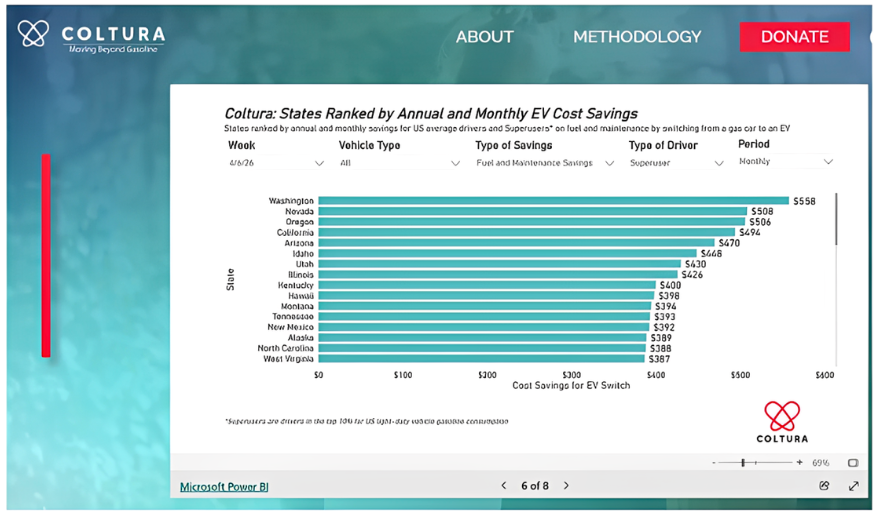
Gas prices are surging, and so are the savings from going electric. According to Coltura’s EV Cost Savings Index, Gasoline Superusers (drivers in the top 10% for gasoline consumption) in Washington state now save an average of $558 per month in fuel and maintenance costs by switching to an EV. Nevada and Oregon follow close behind at $508 and $506. Even in states further down the list, monthly savings for big drivers remain substantial. The math has never been more compelling. Check your state at data.coltura.org/ev-savings-index.
Why Your Support Has Never Mattered More
National average gas prices have surged to more than $4 a gallon. The families feeling it most are the ones who were already spending 15% or more of their income at the pump — disproportionately Black, Latino, and rural drivers with long commutes and no easy alternatives.
The Iran war made the headlines. But this vulnerability was always there. Coltura’s data identified these families years ago. Our tools help them find affordable used EVs and calculate exactly what they’d save. Our policy work pushes states to direct incentives to the drivers who need them most.
Every week that gas stays above $4 a gallon is another week these families are paying a price they can’t afford, for a crisis they didn’t cause.
Your donation helps us move faster. Please give today at coltura.org.
Gas Station of the Month:
Cardiff, Idaho
A gas station in the remote community of Cardiff, Idaho exploded with catastrophic force, killing two people, injuring two others, and destroying a neighboring home, greenhouse, and multiple vehicles. Total damages exceeded $4.7 million.
A new fire marshal’s report found that gross negligence and widespread code violations likely caused the disaster. The station’s aging pumps were corroding and leaking fuel into a coffee can. Gasoline storage tanks that should have been underground were above ground and had no overflow alarms or automatic shutoffs. A door that should have been airtight was propped open, allowing gasoline vapors to enter the convenience store, where a furnace inside the convenience store lacked a face cover.
When a routine fuel delivery caused a tank to overflow, gasoline vapors flooded the building and ignited. The resulting explosion sent a fuel tanker flying across the street and the storage tanks into a neighbor’s property 100 yards away. The building collapsed, rupturing fuel lines and triggering a chain of additional blasts that witnesses said reached 20 feet high.
Want more stories like these in your inbox? Sign up below for your free subscription to Gasoline Phaseout News!
Culture Corner:
China Has Crossed the Tipping Point
In 2025, the world’s largest car market did something remarkable: it went majority electric.
In 2025, 51% of all vehicle sales in China were electric, rising from just 6% in 2020. This isn’t a niche trend anymore. It’s a cultural and industrial transformation.
Analysts point to this 50% threshold as a tipping point that quickly leads to EV dominance across an entire market. Norway hit it in 2020, and by 2024 was at 90%.
What’s driving it? A combination of government support, city-level incentives, battery manufacturing dominance that drove costs down, and charging infrastructure. China has more public EV charging stations than any other country, and Chinese domestic brands now account for nearly 70% of its passenger car market.
China has reinvented the car industry around EVs. The rest of the world is watching, and falling behind.