


 Gas Car "Phase Out" States (Updated 2026)

This is about new car sales — not taking existing gas cars off the road.
Learn which states are on a gas car phase-out path, what the rules actually do, and where ACC II (Advanced Clean Cars II), partial clean-car standards, and other watch states stand now.

If you are searching for gas car phase out states, the most important thing to know is that there is no nationwide U.S. gas car ban.
While the US has not yet joined the many countries setting a new gas vehicle sales phaseout date, multiple states have committed to follow California’s Advanced Clean Cars II (“ACC II”) regulation to end sales of new gas cars by 2035.
Most headlines use dramatic shorthand, but these policies usually apply to new passenger-vehicle sales — not to people who already own gas cars, drive gas-powered vehicles, or buy used gasoline cars.
What this article really covers is which states are beginning to phase in cleaner new vehicles and expand access to options that can cost less to fuel, produce less pollution, and reduce dependence on gasoline. In other words, these policies are often better understood as a phase-in of cleaner vehicles, not a ban on existing cars.
The bigger idea is not simply taking gas cars away. It is about helping more people move toward cleaner, more practical vehicles that are more affordable to fuel and maintain. That is why it is important to look past the “gas car ban” headlines and understand what these rules actually do — and which states are truly on that path.
In This Article
- Quick answer: what states are banning gas cars?
- What states will ban gas cars by 2035?
- When will gas cars be banned in the U.S.?
- Why states are moving away from gasoline vehicles
- Main chart: gas car phase out states
- Other states to watch
- Some cities are taking steps too
- Gasoline Superuser Approach
- Conclusion
- FAQ: gas car bans, phaseouts, and 2035 rules
Quick Answer: What States Are Banning Gas Cars?
No U.S. state is completely banning gas cars. Instead, a group of 12 states and Washington D.C. have adopted policies that phase in cleaner new vehicles over time by setting requirements for new passenger-vehicle sales.
As of 2026, most states are on a full California-linked ACC II pathway — which moves toward all new passenger vehicles meeting zero-emission standards by model year 2035 if the rules remain in effect. California, Maryland, Massachusetts, New Jersey, New York, Oregon, Rhode Island, Vermont, and Washington have adopted this framework. Washington, D.C. has also adopted this framework.
Other states often included in lists of gas car phase out states — including Colorado, Delaware, and New Mexico — have adopted related clean-car standards, but their current rules are more limited and do not yet follow the same full 2035 pathway.
- These rules affect new vehicle sales. They do not make existing gas cars illegal, and they do not ban used gas-car sales.
- The jurisdictions below are all included because they have adopted an ACC II, ACC II-style, or similar clean vehicle sales framework for new passenger vehicles. But they are not all currently active in exactly the same way. Some are fully moving forward under their adopted rules, while others are operating under enforcement discretion, temporary pauses, delayed penalties, time-limited program designs, or other near-term implementation changes.
- That is why the Status column matters: it shows whether a program is fully active, partially paused, time-limited, or being administered with added flexibility.
Learn more about each state's specific phase out plans and status in the gas car phase out states chart below.
For further information:
- For a broader look beyond the main phaseout jurisdictions, see the second state chart, which covers Connecticut, Hawaiʻi, Illinois, Maine, Minnesota, Nevada, Pennsylvania, Virginia, and Wisconsin. These states are still important because of live rulemakings, coalition activity, earlier California-linked standards, or recent shifts in policy direction.
- You can also visit the cities section to see how places like Los Angeles, Washington, D.C., San Diego, Seattle, New York City, Denver, Boston, Baltimore, and San Francisco are pushing local EV adoption, charging, and fleet electrification.
-
For a broader international picture, see Gasoline Vehicle Phaseout Advances Around The World. It tracks gas car bans, ICE bans, and phaseout targets around the world while also showing how U.S. state policy fits into the bigger shift away from gasoline.
-
For a California-specific breakdown, see The California Ban On Gas Cars — What You Need To Know In 2026. It explains how California’s new-sales rule works, what changed in 2025 and 2026, and why existing and used gas cars are not banned.

Why States Are Moving Away From Gasoline Vehicles
The push away from gasoline is happening because the United States still uses an enormous amount of it.
- Coltura’s gasoline-consumption research notes that the United States burns more than one-third of the world’s gasoline despite making up only about 4% of the global population. Learn more about U.S. gasoline consumption data.
- Most of that gasoline goes into the vehicles people drive every day. Around 91% of gasoline burned in the United States goes into light-duty vehicles like cars, SUVs, and small trucks.
- Gasoline and diesel use in the U.S. transportation sector released roughly 1,489 million metric tons of CO2 in 2023.
- Vehicle emissions contain toxic pollutants linked to asthma, heart disease, lung disease, cancer, and other serious health harms. Learn more about gasoline facts and pollution from vehicles.
That is why states adopt or consider clean-car rules. These policies are meant to cut gasoline use, reduce tailpipe pollution, expand access to cleaner vehicles, and move the market toward alternatives that can improve both climate and public-health outcomes over time.
For a broader public-health look at why reducing gasoline use matters, see How To Reduce Air Pollution In 2026.
Pollution Ends Where Action Begins
For over a decade, Coltura has been leading the movement to move America beyond gasoline — turning complex policy, data, and real-world trends into clear, actionable insight.
Join thousands of people learning, sharing, and helping move America toward cleaner, more affordable transportation.
Sign up to get monthly news and inspiration from our award-winning nonprofit and the Beyond Gasoline Movement.
Main Chart: Gas Car Phase Out States
Below is a quick, source-first reference for where Advanced Clean Cars II and similar clean vehicle sales standards have been adopted or implemented — including the rule type, a plain-English overview, a brief status, and direct links to the relevant pages with more information.
Important Notes:
- These policies regulate new passenger-vehicle sales. They do not make existing gas cars illegal.
- Many jurisdictions adopt California-linked standards under Clean Air Act “Section 177,” so enforceability can shift with federal waiver actions and court outcomes.
- Policy status can change quickly. Last update: March 2026.
Federal Posture (ACC II Waiver + CRA + Litigation)
- January 6, 2025: EPA’s ACC II waiver notice of decision was published in the Federal Register.
- March 6, 2025: GAO said its view is that these California waiver notices are not CRA rules because they are better understood as orders under the APA, and GAO also noted that even if they were treated as rules, they would still fall within a CRA exclusion.
- June 12, 2025: CRA disapproval of the ACC II waiver notice was enacted as Public Law 119-16 (H.J. Res. 88), and California plus allied states filed suit challenging that action: complaint PDF.
- October 2, 2025 / March 6, 2026: CARB’s emergency vehicle-emissions rulemaking page says OAL approved the initial emergency rulemaking and it was filed with the Secretary of State effective October 2, 2025. CARB later posted a first emergency readoption notice on March 6, 2026.
- March 12, 2026: DOJ and DOT sued California and CARB over California’s vehicle-emissions and ZEV rules: federal complaint PDF.
What this means: The federal posture is more contested than it was in early 2025. ACC II-related disputes now include the waiver fight, the CRA disapproval law, California’s challenge to that law, CARB’s emergency rulemaking, and the March 2026 federal suit, so check the links above for the latest official posture.
| Jurisdiction | Rule Type | Brief Overview | Status | Sources |
|---|---|---|---|---|
| California | ACC II (through MY 2035) | California’s Advanced Clean Cars II sets a year-by-year manufacturer standard that ramps up the share of new passenger cars and light-duty trucks that meet zero-emission standards, including battery-electric, hydrogen fuel-cell, and a limited plug-in hybrid pathway. It affects new sales, not owning or selling used gas cars. | Adopted. EPA granted the associated waiver action in January 2025. Ongoing federal and court developments can still affect timing and enforceability. | |
| Colorado | Clean Cars Standard (manufacturer sales/credit standard) | Colorado’s Clean Cars Standard is a state-run manufacturer sales and credit requirement that increases the share of new light-duty vehicles that are qualifying electric vehicles over time, including battery-electric, plug-in hybrid electric, and fuel-cell electric vehicles. It is not a single “ban date” — compliance is tracked annually under state rules. | Adopted and implemented through state rules. Annual compliance applies to covered manufacturers, and the standard directs manufacturers to sell 82% electric vehicles by MY 2032. | |
| Delaware | ACC II-style (time-limited under current regulation) | Delaware adopted a California-linked, credit-based clean vehicle standard for new passenger cars and light-duty trucks for the model years specified in the state’s program design. It does not prohibit owning, driving, or selling used gas cars. | Adopted. Delaware’s current program design is time-limited: it starts with MY 2027, ramps through MY 2032, and expires in MY 2033 unless updated. | |
| Maryland | ACC II (Maryland program adoption) | Maryland adopted California-linked ACC II requirements for new passenger cars and light-duty trucks. State executive actions and implementation materials describe how the program is administered and how early model-year compliance is handled. | Adopted. A 2025 executive order directs near-term enforcement discretion, including declining penalties for ACC II ZEV delivery shortfalls for MY 2027 and MY 2028, subject to conditions in the order. | |
| Massachusetts | ACC II (through MA LEV framework) | Massachusetts implements California-linked clean car standards through its Low Emission Vehicle program. The state has also issued compliance guidance describing how near-term ACC II requirements are handled. | Adopted. MassDEP announced a two-year pause of electric vehicle sales requirements for manufacturers and issued enforcement discretion affecting MY 2026 and MY 2027 ACC II requirements. | |
| New Jersey | ACC II (NJ program adoption) | New Jersey adopted California-linked ACC II standards as part of its clean vehicles program. It regulates manufacturer deliveries of new passenger cars and light-duty trucks over time, not used-car ownership. | Adopted. NJDEP administers implementation through its Drive Green and clean vehicles materials. | |
| New Mexico | ACC II-style (Clean Car Rule / 20.2.91 NMAC) | New Mexico’s Clean Car Rule aligns new-vehicle sales standards with California-linked requirements through state regulation. Manufacturers comply using annual credits, reporting, and verification requirements described in the rule. | Adopted in regulation. State materials summarize a ramp beginning in MY 2027 and increasing through MY 2032. | |
| New York | ACC II (regulation adopted) | New York adopted ACC II for new passenger cars and light-duty trucks through regulation. The program sets annual manufacturer requirements and includes the reporting and compliance structure used for implementation. | Adopted. NYSDEC publishes implementation updates and any near-term compliance posture materials alongside the program. | |
| Oregon | Oregon Clean Vehicles / ORLEV (includes ACC II) | Oregon implements California-linked clean vehicle standards for new vehicles through its Clean Vehicles / ORLEV framework, including Advanced Clean Cars II. DEQ materials cover program basics and additional implementation guidance for early model years. | Adopted. Oregon’s ACC II program begins with MY 2026, and DEQ issued enforcement discretion specific to the MY 2026 ZEV sales requirement while continuing to enforce other ACC II obligations. | |
| Rhode Island | ACC II (Rhode Island program adoption) | Rhode Island aligns its new-vehicle requirements with California-linked clean vehicle standards through RIDEM’s program framework. RIDEM’s ACC II materials provide a plain-English summary and point to program documentation. | Adopted. RIDEM maintains the program page and supporting materials as the primary current-status reference. | |
| Vermont | ACC II (VT clean car regulations) | Vermont adopted ACC II through state air regulations for new passenger vehicles. State materials now describe an executive-order-based compliance flexibility and enforcement-discretion posture for near-term implementation. | Adopted. Executive Order 04-25 directs an enforcement-discretion posture for ACC II ZEV sales requirements for the duration of the order, which continues through Dec. 31, 2026. | |
| Washington | Clean Vehicles Program (WAC 173-423; includes ACC II) | Washington administers clean vehicle standards through its Clean Vehicles Program under WAC 173-423. Ecology’s rulemaking pages track updates, supporting documents, and program changes over time. | Adopted. Ecology guidance pauses certain ACC II compliance mechanics, including deficit generation and vehicle value surrender requirements, through June 6, 2026, while continuing other program administration. | |
| Washington, D.C. | Adoption of California vehicle emission standards (includes ACC II) | Washington, D.C. adopted California vehicle emission standards updates for new passenger cars and light-duty trucks, including ACC II. DOEE’s final rulemaking notice and the D.C. Register publication provide the controlling documentation. | Adopted via DOEE final rulemaking. Implementation is administered through D.C.’s California-linked framework. |
Other States To Watch
These states still matter in the broader clean-car conversation for different reasons. Some have live rulemakings, coalition activity, or earlier California-linked standards, while others recently changed course, ended earlier programs, or remain legally unsettled.
| State | Why It Matters | Status (March 2026) | Sources |
|---|---|---|---|
| Connecticut | A recent example of a state that seriously weighed updated California-linked standards, then stopped short of adopting them. | DEEP says the proposed updated emissions standards were not adopted. Connecticut remains under its existing LEV/ZEV program. | |
| Hawaiʻi | A newer entrant in the multistate clean-cars conversation through coalition activity rather than a formal ACC II adoption. | Hawaiʻi joined the coalition in September 2025. It is part of the broader policy conversation, even though it is not currently on an ACC II pathway. | |
| Illinois | One of the clearest cases of a major clean-car rulemaking that advanced, drew heavy attention, and then hit pause. | The Illinois Pollution Control Board has stayed the rulemaking pending the resolution of the California federal case or a further Board order. Written status updates are due every six months beginning March 5, 2026. | |
| Maine | A state where the clean-car path shifted recently, from considering broader updates to returning to the federal framework. | Maine DEP’s January 2026 report says ACC I remained in effect through MY 2025 and that Maine reverted to federal standards for light-duty vehicles in 2026. | |
| Minnesota | A recent clean-cars state where an earlier California-linked program expanded vehicle availability and then came to a close. | Minnesota Pollution Control Agency says Clean Cars Minnesota ended after MY 2025. The state is continuing broader transportation-emissions work through other programs and planning efforts. | |
| Nevada | A recent California-linked clean-car state whose program applied to MY 2025, but which did not move on to adopt California’s newer ACC II framework. | Nevada required manufacturer compliance for MY 2025 under LEV III standards and the state’s Zero Emission Vehicle program, but later Nevada state materials say the state did not adopt ACC II and that Clean Cars Nevada is effective for MY 2025 only, with Nevada reverting to federal LEV and ZEV standards starting in MY 2026. | |
| Pennsylvania | An active clean-vehicle state whose program still matters, even though it stops short of the full California ZEV model. | Pennsylvania’s program is active, but it is LEV-only. The state says its Clean Vehicle Program does not incorporate California’s ZEV requirements. | |
| Virginia | A state where the next phase of clean-car policy is still being shaped by both existing rules and recent legal guidance. | Virginia’s administrative code still shows a California-linked LEV and ZEV framework beginning with MY 2025, while the 2024 Attorney General opinion says the Board is not required to adopt California’s ACC II standards for MY 2026 and beyond. | |
| Wisconsin | Another newer coalition state, showing how the clean-cars conversation is still expanding beyond formal ACC II adopters. | Wisconsin joined the coalition in September 2025. That makes it relevant in the broader clean-car conversation, even though it is not currently on an ACC II pathway. |
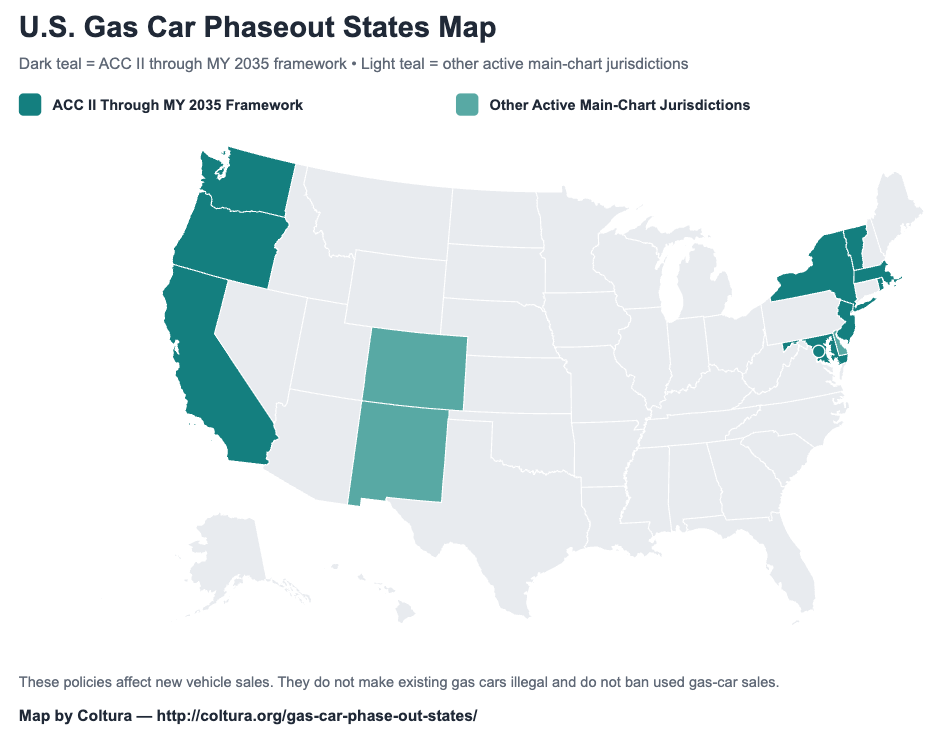
U.S. Gas Car Phaseout Map (March 2026)
This map shows the 12 states and Washington, D.C. in the main chart only. It separates the 10 jurisdictions on the ACC II through MY 2035 framework from the 3 other currently active main-chart jurisdictions that are not on that same MY 2035 framework.
Every jurisdiction in this map has adopted an ACC II, ACC II-style, or similar clean vehicle sales policy for new passenger vehicles, but they are not all in the same current posture.
Some are fully in effect, while others are subject to enforcement discretion, temporary pauses, delayed penalties, or time-limited rules.
Read the Status column carefully in the chart above for that reason.
These programs regulate new vehicle sales and manufacturer obligations — not ownership of existing gas cars and not used-car sales.
Some Cities Are Taking Steps Too
Most of the strongest U.S. clean-car rules still run through states, not cities. But some cities are also trying to speed the shift away from gasoline through local EV adoption targets, for-hire vehicle rules, charging buildout, and municipal fleet electrification. In most cases, these city policies do not ban people from owning or driving gas cars, and they usually do not ban the sale of new gas cars to consumers the way state-level ACC II-style rules do.
- Los Angeles has one of the clearest citywide examples. Under L.A.’s Green New Deal targets, the city says it wants the percentage of zero-emission vehicles in the city to reach 25% by 2025, 80% by 2035, and 100% by 2050. That is not a ban on buying or owning a gas car in Los Angeles, but it is a strong local signal that the city wants the overall vehicle mix to move away from gasoline over time.
- Washington, D.C. is another important example. D.C.’s Sustainable DC targets and Transportation Electrification Roadmap call for 25% of vehicles registered in the District to be zero-emission by 2030. The District also goes further than many cities by using the Clean Energy DC Omnibus Act to push public fleets, certain larger private and commercial fleets, taxis, and limousines toward zero-emission vehicles over time.
- San Diego uses a slightly different local benchmark. Its Zero Emission Vehicles Program says the city aims for 16% of all light-duty vehicle miles traveled to be electric by 2030, rising to 25% by 2035. That matters because it focuses less on a simple vehicle count and more on how much real-world driving is shifting away from gasoline.
- Seattle also does not have a consumer sales ban, but it has a broad local transportation target. Under Seattle’s Transportation Electrification Blueprint, the city says 90% of all personal trips should be zero-emission by 2030. Seattle also says shared mobility should be zero-emission, which includes services like taxis, rideshare, scooters, bikes, and carshare rather than a blanket ban on personal gas-car ownership.
- New York City combines consumer adoption goals with a targeted rule for for-hire vehicles. NYC says 400,000 vehicle owners will need to switch to EVs by 2030, and the city is planning a major charger buildout to support that shift. Separately, the Green Rides Initiative requires high-volume for-hire fleets such as Uber and Lyft to move toward 100% zero-emission or wheelchair-accessible trips by 2030, which is a meaningful local clean-transportation rule even though it is not a general ban on new gas-car sales.
Other city-level examples are worth watching too.
Denver’s EV Action Plan says the city aims for 15% of vehicle registrations to be electric by 2025, 30% by 2030, and 100% of light-duty vehicles by 2050.
Boston’s Zero-Emission Vehicle Roadmap set aspirational targets of 8% of vehicles registered in Boston and 23% of new car purchases in Boston being EVs by 2025. These are still not city bans on consumer gas-car sales, but they show that some local governments are trying to move the market faster.
Cities are also using their own fleets to lead by example
In New York City, city law now puts the municipal fleet on a full electrification path, with light- and medium-duty city vehicles expected to be electric by 2035 and heavy-duty by 2038, subject to exemptions and implementation constraints.
Washington, D.C. says in the Clean Energy DC Omnibus Act that public fleets must be 50% zero-emission by 2030 and 100% zero-emission by 2045, and the law also reaches certain larger private and commercial fleets, taxis, and limousines.
Baltimore requires 100% of administrative fleet vehicle procurement to be zero-emission by January 1, 2030, and San Francisco requires all light-duty vehicles in the city fleet to be zero-emission, subject to waivers and exceptions. Los Angeles has also said its EV Master Plan charts a course toward fully electrifying the City fleet.
It is often at the local level that real change starts.
A few residents speaking up about EV charging, cleaner transit, or city fleet electrification can help move a town or city much faster than people think.
For practical local steps you can take right now, read How to Improve Air Pollution: 7 Actions You Can Take In 2026.

Gasoline Superuser Approach
State-level standards can help move the market away from gasoline over time, but on their own they do not reduce gasoline use quickly enough. To cut gasoline use faster, we need to help the drivers using the most gasoline — “Gasoline Superusers” — switch to EVs as soon as possible.
Across the United States, Gasoline Superusers use roughly one-third of all gasoline, often because they have to travel long distances between affordable housing and work. Learn more about Coltura’s gasoline superuser approach.
Coltura’s 2024 report, "Country Crossroads," looks at rural Gasoline Superusers — a small share of rural drivers who make up less than 4% of the U.S. population but account for nearly 13% of the nation’s gasoline use.
You can also watch Coltura’s free webinar on how the gasoline superuser strategy can help reduce vehicle emissions faster and more equitably.
To explore the broader damage caused by gasoline, learn more about the life cycle harms of gasoline.
Conclusion
The United States does not have a single national gas car ban, but a growing group of states has adopted ACC II or similar clean-car standards for new vehicle sales. The main chart shows where those rules are actually in place, while the second chart helps separate other states that still matter in the broader clean-car conversation — including earlier California-linked programs, coalition states, live proposals, and states whose policy paths recently changed.
Curious how much you could save switching to an EV? Get a quick estimate of your fuel & maintenance savings below!
*Disclaimer: This tool is only intended to provide an estimate of potential savings. Actual results will vary. Learn more about the calculation and the Electric vs Gas Calculator here.
FAQ: Gas Car Bans, Phaseouts, And 2035 Rules
What states are banning gas cars?
The current legal status ranges, but 12 states have clean car standards that will limit the sale of new gas vehicles over time. The states are California, Colorado, Delaware, Maryland, Massachusetts, New Jersey, New Mexico, New York, Oregon, Rhode Island, Vermont, Washington plus Washington, D.C. These include full ACC II / 2035 states, shorter-timeline ACC II-style programs, and Colorado’s separate state-run standard. Learn more about how a phaseout-style rule works in The California Phase Out of Gas Cars — What You Need To Know In 2026.
What states will ban gas cars by 2035?
In the most common headline framing, the clearest 2035 jurisdictions are California, Maryland, Massachusetts, New Jersey, New York, Oregon, Rhode Island, Vermont, Washington, and Washington, D.C. Delaware and New Mexico currently run through MY 2032, while Colorado uses a different state-run standard.
When will gas cars be banned?
There is no single U.S. date. In the U.S., this question usually means when certain states will require cleaner new car sales over time.
Will gas cars be banned in the U.S.?
There is no nationwide U.S. gas car ban date. The major U.S. policy discussions are state-by-state.
Are gas cars going away?
Existing gas cars are not going away overnight. Even in states with phaseout-style rules, current gas cars can stay on the road for many years because the policies mainly affect the mix of new vehicles sold.
How long will gas cars be around?
Gas cars will likely remain on U.S. roads for many years. State clean-car standards mostly change future sales requirements, not whether current owners can keep driving.
What happens to gas cars after 2035?
Existing gas cars remain legal to own and drive after 2035. The main 2035 policies are about new vehicle sales, not confiscating older vehicles or banning used-car sales.
What states are not banning gas cars?
Any state not in the main chart above is not on the same adopted ACC II, ACC II-style, or clearly identified equivalent pathway tracked on this page. Some still have older LEV or ZEV rules, earlier California-linked programs, proposals, coalition activity, or related programs, which is why the second chart matters. For a broader international comparison, see Gasoline Vehicle Phaseout Advances Around The World.
When will petrol cars be banned?
In the United States, there is no nationwide petrol or gas car ban date. This page focuses on state rules for new vehicle sales, which is what most people really mean when they search this question.
What does “ICE ban” mean?
“ICE” means internal combustion engine. In U.S. policy talk, an “ICE ban” usually refers to rules that phase down the sale of certain new gasoline vehicles over time, not bans on owning existing cars. For more on why these policies exist, see U.S. Gasoline Consumption and Pollution From Vehicles.
What 17 states are banning gas cars?
You may see references to 17 states because some lists count additional states that adopted earlier California vehicle-emissions standards or other California-linked programs. On this page, the main chart tracks 13 jurisdictions on a current ACC II or similar pathway, while other states are discussed separately in the second chart. For more on California and other states adopting California standards, see The California Ban On Gas Cars — What You Need To Know In 2026.
Can you still drive gas cars after 2035?
Yes. Existing gas cars remain legal to own and drive after 2035. These policies are mainly about future new-vehicle sales, not taking existing cars off the road or banning used-car sales.
What year will electric cars be mandatory?
There is no single nationwide U.S. year when electric cars become mandatory. In the United States, the main policy changes are state-by-state rules affecting the mix of new vehicles sold over time. Some states are on a 2035 pathway, while others use shorter timelines or different state-run standards.
Should I buy a gas or diesel car?
If long-term fuel costs, maintenance savings, and pollution matter to you, it is worth comparing EV options closely before buying a new gas or diesel vehicle. For more on the pollution side of that choice, see Pollution From Vehicles.