


 Gasoline Vehicle Phaseout Advances Around The World (Updated 2026)
Learn about gas car bans and ICE bans around the world.

The long list of countries planning to phase out sales of fossil fuel vehicles shows a trend of moving beyond gasoline to cleaner, cheaper alternatives.
The latest gasoline car phaseout advances by over 50 countries – including gas car bans and diesel car bans – can be found below.
Important 2026 Note
This page distinguishes between binding regulations, official targets, and pledges. Some high-profile policies (including in the EU and U.S.) are also subject to proposals, legal challenges, or federal actions that can shift outcomes.
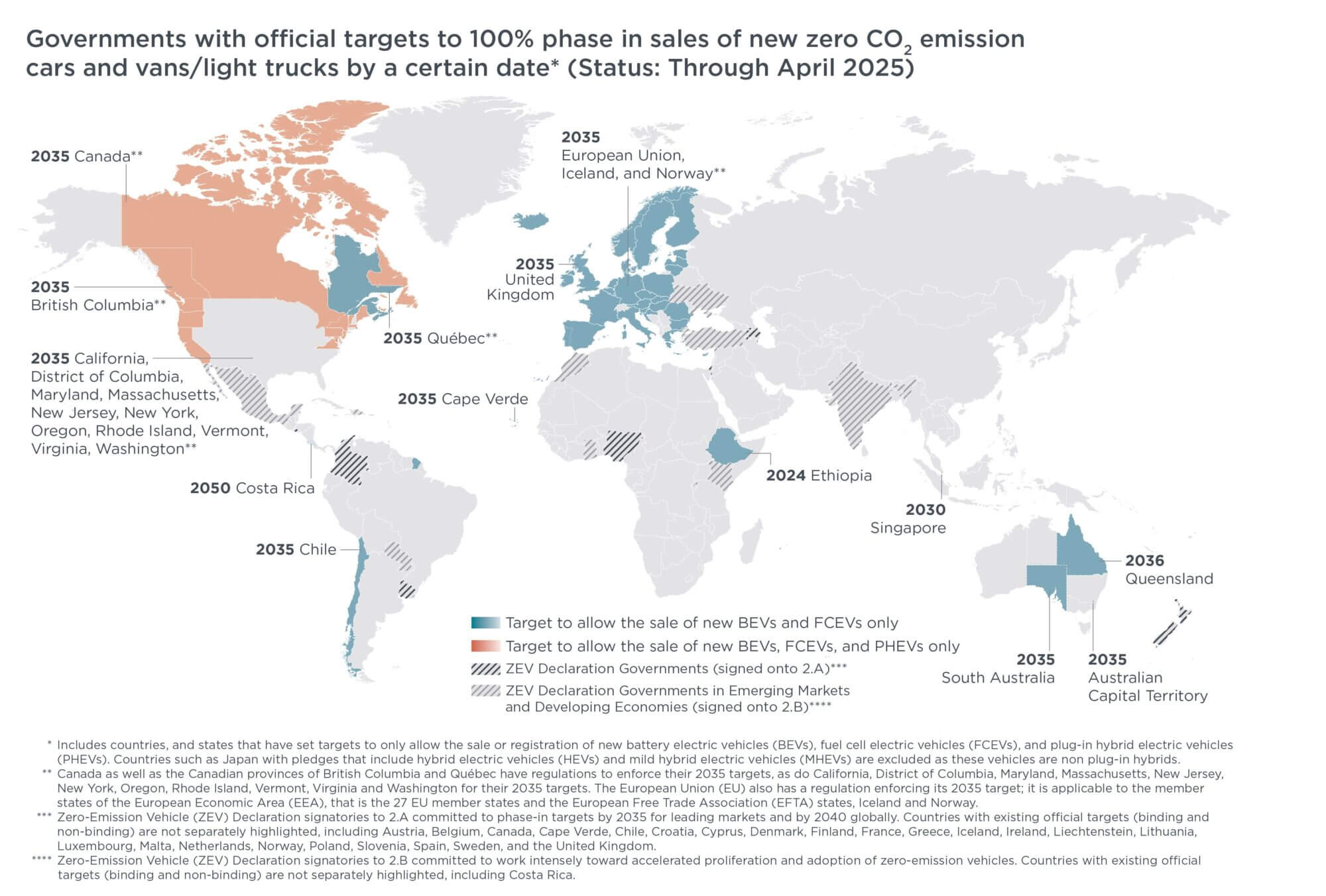
Governments with official target dates for 100% of new car sales to be Zero Emissions Vehicles (ZEVs) – Source The ICCT
World Gasoline Phaseouts
Below is a curated tracker of major policies and targets related to phasing out new gasoline and diesel vehicles.
This country-only table includes 58 national entries connected to gas-car phaseout pathways or zero-emission vehicle commitments. That includes 28 binding regulation rows — mostly countries covered by the EU’s binding 2035 new-car CO₂ standard, plus the United Kingdom’s ZEV mandate pathway — as well as 6 official target rows, 2 policy-action rows, and 22 pledge-only rows.
A gasoline vehicle phaseout is sometimes called an internal combustion engine ban, or ICE ban — but different policies work in different ways. Depending on the place, a “phaseout” can mean:
- Binding sales requirements (example: a manufacturer ZEV mandate)
- Binding emissions standards that effectively require ZEV sales (example: a 100% tailpipe CO₂ reduction requirement)
- Registration or import restrictions (example: restrictions on importing gasoline vehicles)
- Official targets that guide policy but are not enforced as a sales mandate
- International pledges that are not the same as domestic law
As such, the rows in the table below do not all mean the same thing.
Some countries are included because they are covered by binding domestic or EU-linked rules, while others appear because they have official national targets, active policy pathways, or COP26-related international pledges.
For example, the 13 countries that agreed to work intensely toward faster zero-emission vehicle adoption under the COP26 framework are included here as pledge-only entries, not as binding-law rows. That distinction matters because the legal strength, enforcement, and certainty behind each pathway can vary significantly.
Country-only rows. Subnational, city, provincial, and region-only entries are intentionally excluded from this table.
| Country | Policy Type | Year | Notes | Source |
|---|
No matching countries found.
Regions, Territories, And Cities
Subnational policies vary widely. This table separates (1) sales rules or official subnational targets for new vehicles from (2) city access rules such as low-emission, ultra-low-emission, or zero-emission zones that restrict or charge certain vehicles in certain areas.
| Region / City | Country | Policy Type | Start / Target | Scope | What It Does (Plain English) | Primary / Official Source |
|---|---|---|---|---|---|---|
| Aberdeen | United Kingdom | City access rule (LEZ) | 2022 / 1 June 2024 enforcement | City-centre access for non-compliant vehicles | Aberdeen introduced its Low Emission Zone in 2022 with a grace period, and enforcement began on 1 June 2024. Non-compliant vehicles can be fined if they enter the zone. | Aberdeen City Council — Low Emission Zone |
| Australian Capital Territory (ACT) | Australia | Official target / policy intention | 2030 / 2035 | New light vehicles / registrations | The ACT targets 80–90% of new vehicle sales to be ZEVs by 2030 and says it is exploring options to prevent the sale of new light internal combustion vehicles from 2035. | ACT Government — ACT’s Zero Emissions Vehicles Strategy ACT Government — Zero Emissions Vehicles |
| Amsterdam | Netherlands | City access rule (LEZ + zero-emission zones) | 2025 / 2030 | Vans, lorries, mopeds, scooters; diesel LEZ also applies | Amsterdam officially says it has both low-emission zones for some diesel vehicles and zero-emission zones for vans, lorries, mopeds, and scooters. Its current framework includes major rollout points beginning in 2025. | City of Amsterdam — Low and zero emission zone |
| British Columbia | Canada | Binding sales rule (ZEV mandate) | 2026 / 2030 / 2035 | New light-duty vehicle sales or leases | British Columbia’s law sets rising ZEV targets, including 26% in 2026, 90% in 2030, and 100% in 2035, and prohibits non-ZEV consumer sales of covered vehicles from 2035 onward. | BC Laws — Zero-Emission Vehicles Act |
| Brussels-Capital Region | Belgium | Regional access rule (LEZ) | 2018 / 2030 / 2035 | Cars, vans, and other vehicle classes with separate timetables | Brussels has had a Low Emission Zone since 1 January 2018. The official LEZ framework provides a phased timetable rather than a simple all-vehicle ZEZ, with different deadlines depending on vehicle type. | Brussels LEZ — Official practical page |
| District of Columbia | United States | Binding sales rule / ACC II adoption | 2035 | New cars sold in the District | Official District materials say the District signed on to Clean Cars II, requiring all new cars sold in the District to be zero-emission by 2035. | DOEE — EV Charging Challenges notice |
| Dundee | United Kingdom | City access rule (LEZ) | 30 May 2022 / 30 May 2024 enforcement | Inner-ring-road city-centre area | Dundee introduced its LEZ on 30 May 2022 and began enforcement on 30 May 2024. It operates 24 hours a day, 7 days a week. | Dundee City Council — Dundee Low Emission Zone Scheme |
| Edinburgh | United Kingdom | City access rule (LEZ) | 1 June 2024 enforcement | City-centre LEZ | Edinburgh started issuing LEZ fines on 1 June 2024. The zone operates 24 hours a day, 365 days a year and applies to all vehicles except exempt ones. | City of Edinburgh Council — Low Emission Zone |
| Glasgow | United Kingdom | City access rule (LEZ) | 1 June 2023 | City-centre LEZ | Glasgow’s LEZ came into force for all vehicles on 1 June 2023. Vehicles entering the city-centre zone must meet the emissions standards or face a penalty charge. | Glasgow City Council — Glasgow’s Low Emission Zone |
| Hackney + Islington (City Fringe) | United Kingdom | Limited-area access rule (ultra-low-emission streets) | 2018 | Selected streets with timed restrictions | This is not a citywide ZEZ. Hackney and Islington operate ultra-low-emission streets in the City Fringe with timed restrictions that favor ultra-low-emission vehicles and permit holders. | Hackney Council — Ultra low emission streets Islington Council — Ultra low emission streets |
| London (ULEZ) | United Kingdom | City access rule (ULEZ) | In force | Driving within the ULEZ | London’s ULEZ does not ban ownership. It charges vehicles that do not meet the minimum standards. For cars, the main thresholds are Euro 4 for petrol and Euro 6 for diesel. | TfL — ULEZ cars |
| Multiple municipalities | Netherlands | City access rule (municipal zero-emission zones) | 1 January 2025+ | City logistics — delivery vans and lorries | The first Dutch municipal zero-emission zones for city logistics started on 1 January 2025. More municipalities are following, and transition rules and exemptions apply. | Op weg naar ZES — Where are the ZE zones? |
| Oxford | United Kingdom | City access rule (charge-based ZEZ pilot) | 28 February 2022 | Selected city-centre streets | Oxford’s Zero Emission Zone is a pilot. It became operational on 28 February 2022. Most non-zero-emission vehicles are not outright banned from the pilot area; instead, many can still enter if they pay the daily charge or qualify for an exemption or discount. | Oxfordshire County Council — About Oxford’s ZEZ Oxfordshire County Council — ZEZ charges |
| Paris / Métropole du Grand Paris | France | City / metropolitan access rule (ZFE / Crit’Air) | 1 January 2025 / 2030 goal | Metropolitan access by Crit’Air category | This is best described as a low-emission zone framework, not a pure zero-emission zone. Since 1 January 2025, Crit’Air 3, 4, 5, and unclassified vehicles face broader restrictions in the metropolitan ZFE, while current metropolitan materials also reference a longer-term 2030 clean-fleet objective. | Ville de Paris — ZFE page Métropole du Grand Paris — ZFE page |
| Queensland | Australia | Official target / plan | 2030 / 2036 | Passenger vehicle sales; related fleet and bus targets | Queensland’s strategy includes a target for 50% of new passenger vehicle sales to be ZEVs by 2030 and 100% by 2036, along with bus and government-fleet commitments. | Queensland Government — Queensland’s Zero Emissions Vehicle Strategy |
| Québec | Canada | Official target / policy change | 2035 | New light-duty vehicle sales | In September 2025, Québec announced it would lift the old 2035 prohibition on new gasoline vehicle sales and replace the previous 100% objective with a 90% target combining electric vehicles and plug-in hybrids. | Gouvernement du Québec — September 2025 announcement |
| Rotterdam | Netherlands | City access rule (zero-emission zone) | 1 January 2025 | Delivery vans and lorries / city logistics | Since 1 January 2025, Rotterdam has had a zero-emission zone for delivery vans and lorries. The city says “emission-free” here means electric driving or hydrogen. | Gemeente Rotterdam — Zero-emissiezone voor bestel- en vrachtauto's |
United States Gasoline Phaseout Advances
The United States does not have a nationwide gas car phaseout date. Federal standards and policy direction have shifted over time, and state policies often move faster than federal policy.
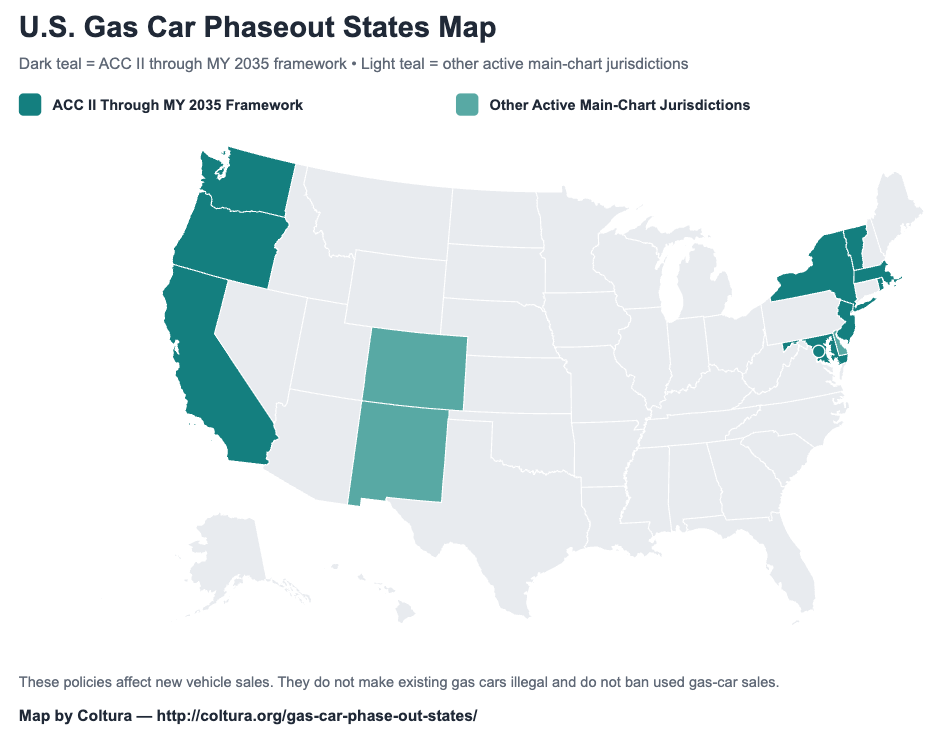
While the US has not yet joined the many countries setting a new gas vehicle sales phaseout date, multiple states have committed to follow California’s Advanced Clean Cars II (“ACC II”) regulation to end sales of new gas cars by 2035.
However, federal actions and lawsuits have made the on-the-ground status more complex. That’s why you’ll see some jurisdictions with rules adopted on paper, while others have issued guidance, delayed enforcement, or adjusted early-year compliance approaches while the federal/legal picture evolves.
Bottom line: The U.S. is best understood as a patchwork of California-linked standards (plus a few state-specific variants), rather than a single national phaseout policy.
See the state list and current status below, or read the full guide here: Gas Car “Phase Out” States – Updated 2026.
Looking to Save Money on an EV?
We put together an easy-to-use cheat sheet with some of the best EV resources.
It's a must-read for people considering an EV.
Simply enter your email to get the free cheat sheet and receive monthly news and inspiration from our nonprofit.
Gasoline Car Phaseout In California
California’s ACC II requires automakers to sell an increasing share of new passenger vehicles that meet zero-emission standards over time, reaching a 2035 endpoint under the program’s design.
Learn more about the gas car phaseout in California.
The percent of new vehicles that must meet zero-emission standards each year under ACC II is as follows:

Gas Car Phase Out States (2026): Full List + Status
California, Colorado, Delaware, Maryland, Massachusetts, New Jersey, New Mexico, New York, Oregon, Rhode Island, Vermont, Washington, and Washington, D.C. are the main jurisdictions tracked here.
Most of these are on the full California-linked ACC II pathway toward model year 2035, while Colorado, Delaware, and New Mexico currently use related clean-car standards with different timelines or structures.
As of 2026, California’s rule sits at the center of a broader federal and legal fight, implementation in other states has become more uneven, with some jurisdictions moving forward and others using delays, pauses, or enforcement discretion for early model years.
For the full explanation, state-by-state status, and source links, read Gas Car “Phase Out” States.
Gasoline Superuser Approach
While state-level standards help ensure an eventual end to gasoline use, they don’t cut gasoline use fast enough on their own. To maximize gasoline reduction, we must help those drivers using the most gasoline (“Gasoline Superusers”) switch to EVs as soon as possible.
Across the US, Gasoline Superusers are using about one-third of all the gasoline — often because they must commute long distances between affordable housing and jobs. Learn more about Coltura’s gasoline superuser approach.
Coltura’s report, "Country Crossroads," published in 2024, sheds light on rural Gasoline Superusers — a small subset of rural drivers who, despite comprising less than 4% of the US population, account for nearly 13% of the nation's gasoline consumption.
Learn from our free webinar about how the gasoline superuser approach can help reduce vehicle emissions faster and more equitably.
Learn more about the life cycle harms of gasoline.

Pollution Ends Where Action Begins
For over a decade, Coltura has been leading the movement to move America beyond gasoline — turning complex policy, data, and real-world trends into clear, actionable insight.
Join thousands of people learning, sharing, and helping move America toward cleaner, more affordable transportation.
Sign up to get monthly news and inspiration from our award-winning nonprofit and the Beyond Gasoline Movement.
Curious how much you could save switching to an EV? Get a quick estimate of your fuel & maintenance savings below!
*Disclaimer: This tool is only intended to provide an estimate of potential savings. Actual results will vary. Learn more about the calculation and the Electric vs Gas Calculator here.