


 World Gasoline Vehicle Phaseouts - What To Know In 2026

Last updated: September, 2026
When will gas cars be banned? See current 2030, 2035 and 2040 rules, targets and pledges by country—and what they mean for existing gas cars.

There is no single worldwide date when gasoline cars will be banned. Countries are using different 2030, 2035, 2040 and later deadlines, and the policies range from binding new-vehicle rules to EV targets, import restrictions and international pledges.
Most of these policies concern new vehicle sales or registrations. They generally do not make existing gasoline cars illegal to own or drive.
Around the world, governments are using a mix of gasoline car phaseouts, diesel restrictions, zero-emission vehicle targets, low-emission zones, and clean-car sales rules to reduce pollution from new vehicles. These policies do not all work the same way: some are binding sales requirements, some are official targets, and some are city access rules that charge or restrict higher-polluting vehicles in certain areas.
Coltura's 2026 tracker organizes gasoline vehicle phaseout policies by type, so readers can quickly see the difference between a national gas car phaseout, a zero-emission vehicle sales target, and a city low-emission zone.
For U.S.-specific details, see our guides to the gas car phaseout states and the California gas car ban.
For more context on why these policies matter, read Coltura’s gasoline facts and our guide to pollution from vehicles.

World Gasoline Phaseout Map (2026)
The map above shows countries, states, provinces, cities, and regions with policies, targets, or pledges related to reducing or phasing out new gasoline and diesel vehicle sales.
These policies generally affect new vehicle sales or registrations, not existing gas cars already on the road.
World Gasoline Phaseouts By Country
Below is a curated tracker of major country-level and supranational policies, targets, and commitments related to phasing out or reducing sales of new gasoline and diesel vehicles.
This list includes 65 country entries connected to gas-car phaseout pathways, zero-emission vehicle targets, electric vehicle adoption goals, or international zero-emission vehicle commitments. It also includes the European Union as a separate supranational policy entry because the EU’s current 2035 new-car and van CO₂ standard applies across all 27 EU member countries.
The country entries are grouped into four main categories:
- 27 European Union countries covered by the EU’s current 2035 new-car and van CO₂ standard
- 12 non-EU countries with strong national zero-emission, electric vehicle, cleaner-energy vehicle sales targets, or policy pathways
- 9 countries with partial, hybrid-inclusive, proposed, or long-term EV targets
- 17 pledge-only countries that have signed international zero-emission vehicle commitments but are not listed here as having equivalent domestic phaseout laws
A gasoline vehicle phaseout is sometimes called an internal combustion engine ban, or ICE ban, but different policies work in different ways. Depending on the country or region, a “phaseout” can mean:
- Binding sales requirements, such as a manufacturer zero-emission vehicle mandate
- Binding emissions standards that effectively require a shift toward zero-emission vehicle sales
- Registration or import restrictions, such as limits on importing gasoline or diesel vehicles
- Official national targets that guide policy but may not be enforced as direct sales mandates
- International pledges that signal intent but are not the same as domestic law
Because of those differences, the entries below do not all carry the same legal weight. Some countries are covered by binding domestic or EU-linked rules, while others are included because they have official national targets, active policy pathways, proposed phaseouts, long-term electrification goals, or international zero-emission vehicle pledges.
The pledge-only section is grouped separately because the Zero Emission Vehicles Declaration commits signatories to work toward all new car and van sales being zero-emission globally by 2040, and by no later than 2035 in leading markets. That pledge is important, but it is not the same as a binding national law.
European Union
European Union: Current EU law sets a 2035 fleet-wide target of 0 g CO₂/km for new passenger cars and vans, corresponding to a 100% reduction in average tailpipe CO₂ emissions. In December 2025, the European Commission proposed lowering the 2035 tailpipe reduction target to 90%, with the remaining emissions addressed through specified compliance credits. As of September 2026, that proposal has not replaced the existing 100% target.
EU Countries Covered By The 2035 Rule
Austria, Belgium, Bulgaria, Croatia, Cyprus, Czech Republic, Denmark, Estonia, Finland, France, Germany, Greece, Hungary, Ireland, Italy, Latvia, Lithuania, Luxembourg, Malta, Netherlands, Poland, Portugal, Romania, Slovakia, Slovenia, Spain, and Sweden.
Additional EU Country Notes
- Austria: Austria has a more ambitious national target for 100% zero-emission new car, light-commercial-vehicle, and two-wheeler sales by 2030.
- France: France has a national law ending sales of new fossil-fuel light-duty vehicles by 2040, while the EU-wide 2035 new-car and van CO₂ standard now sets the stronger near-term benchmark.
- Ireland: Ireland has a national 2030 target for 100% of new passenger light-duty vehicle sales to be EVs.
- Italy: Italy is listed with a phaseout of new ICE cars by 2035 and light commercial vehicles by 2040. The EU-wide 2035 van standard is stricter than that older national light-commercial-vehicle timeline.
- Netherlands: The Netherlands has a national target for 100% zero-emission new car sales by 2030.
- Portugal: Portugal has national EV sales goals, including 30% EV car sales by 2030 and 100% by 2050. The EU-wide 2035 rule is the stronger near-term legal benchmark for new cars and vans.
Note: Norway is listed separately below because it is not an EU member, even though it is closely connected to the European vehicle market.
Countries With Strong National Zero-Emission Or Electric Vehicle Sales Targets Or Policy Pathways Outside The EU
- Cabo Verde: Official target for 100% of passenger light-duty vehicle sales to be electric by 2035, with interim targets of 35% by 2025 and 70% by 2030.
- Canada: Canada’s existing Electric Vehicle Availability Standard still contains a 100% ZEV requirement for model year 2035, but the federal government formally proposed repealing those sales requirements in August 2026. Canada’s new policy direction instead aims for 75% EV sales by 2035 and 90% by 2040 through strengthened greenhouse-gas standards. The regulatory transition is still underway.
- Chile: Official national electromobility strategy target for 100% of new light- and medium-duty vehicle sales to be zero-emission by 2035.
- Chinese Taipei / Taiwan: Official target for all new passenger cars and two- and three-wheelers to be zero-emission by 2040, with interim passenger-car targets of 30% by 2030 and 60% by 2035.
- Costa Rica: Official target for 100% of new light-duty vehicle sales by 2050, plus separate 2050 zero-emission targets for buses and taxis.
- Ethiopia: Ethiopia has prohibited imports of gasoline- and diesel-powered vehicles since 2024 as part of its strategy to accelerate electric mobility and reduce fuel imports.
- Iceland: Iceland’s clean-transport policy provides for ending new registrations of diesel- and gasoline-powered vehicles after 2030, subject to exceptions and implementation details.
- Israel: Official target for private vehicle sales to be EVs by 2030, alongside broader restrictions and targets for cleaner vehicle sales.
- Norway: Norway’s national goal was for all new passenger cars and light vans sold to be zero-emission by 2025. The transition has been driven primarily through taxes and incentives rather than a legal ban on new fossil-fuel car sales; about 97% of new car sales were electric in 2025.
- Singapore: Singapore ended new diesel car and taxi registrations from January 1, 2025; requires all newly registered cars to be cleaner-energy models from 2030; and has a broader 2040 vision to phase out internal combustion engine vehicles.
- United Kingdom: The UK’s ZEV mandate requires 80% of new cars and 70% of new vans sold in Great Britain to be zero-emission by 2030, rising to 100% by 2035. The updated pathway allows some hybrids and ICE vans to continue until 2035. A formal review of the ZEV Mandate opened in August 2026; the current 2030 and 2035 headline commitments remain in place while the review is underway.
- Vietnam: National transport decarbonization goal for 100% of road transport to use electricity and green energy by 2050.
Countries With Partial, Hybrid-Inclusive, Or Long-Term EV Targets
These countries have important national EV, electrification, or low-emission vehicle targets, but their policies are broader than a simple nationwide ban on new gasoline cars.
- Argentina: Argentina has proposed banning sales of new internal-combustion-engine vehicles from 2041.
- Cambodia: Cambodia has long-term EV adoption targets, including 40% of cars and urban buses to be EVs by 2050 and 70% of motorcycle stock to be electric by 2050.
- China: China has major new-energy-vehicle policy targets and development plans, but not a simple nationwide deadline ending new gasoline-car sales.
- Japan: Japan’s target is for all new passenger-car sales to be “electrified” by 2035, a category that includes hybrids as well as EVs, plug-in hybrids, and fuel-cell vehicles.
- Nepal: Nepal has strong EV sales targets, including high private passenger vehicle EV shares by 2030 and 2035, but not a simple one-date phaseout for all new gasoline-car sales.
- New Zealand: New Zealand’s first emissions reduction plan described a goal that all new cars would be low- or zero-emission by 2035. Current policy is better characterized by the Clean Vehicle Standard, which sets average CO₂ targets for new and used vehicles entering the fleet, rather than a binding 2035 ban on new gasoline-car sales.
- Nigeria: Nigeria has a long-term target for a full EV transition by 2060, with smaller interim EV and hybrid targets.
- Pakistan: Pakistan targets a 30% EV share of light-duty vehicle sales by 2030 and 90% by 2040, plus related targets for trucks, buses, and two- and three-wheelers.
- South Korea: South Korea targets high shares of “eco-friendly” vehicle sales by 2030, a category that includes BEVs, FCEVs, PHEVs, and hybrids.
Countries With International Pledge Commitments
The countries below are national-government signatories to the Zero Emission Vehicles Declaration. The declaration commits signatories to work toward all new car and van sales being zero-emission globally by 2040, and by no later than 2035 in leading markets. A pledge is not the same as a domestic law, so these countries are grouped separately from countries with national regulations, formal phaseout laws, or detailed national EV sales targets.
Armenia, Azerbaijan, Colombia, Dominican Republic, El Salvador, Ghana, Holy See, India, Kenya, Liechtenstein, Mexico, Morocco, Paraguay, Rwanda, Türkiye, Ukraine, and Uruguay.
Gasoline Phaseouts In Regions, Territories, And Cities
Subnational policies vary widely. This table separates (1) sales rules or official subnational targets for new vehicles from (2) city access rules such as low-emission, ultra-low-emission, or zero-emission zones that restrict or charge certain vehicles in certain areas.
September 2026 update: This subnational tracker includes 19 selected region, city, territory, and provincial entries: 7 sales, registration, or official ZEV pathway entries and 12 city or regional access-rule entries. These policies are separate from the country-only gasoline phaseout tracker above.
| Region / City | Country | Policy Type | Start / Target | Scope | Briefly What It Does | Primary / Official Source |
|---|---|---|---|---|---|---|
| Aberdeen | United Kingdom | City access rule (LEZ) | 2022 / 1 June 2024 enforcement | City-centre access for non-compliant vehicles | Aberdeen introduced its Low Emission Zone in 2022 with a grace period, and enforcement began on 1 June 2024. Non-compliant vehicles can be fined if they enter the zone. | Aberdeen City Council — Low Emission Zone |
| Australian Capital Territory (ACT) | Australia | Official ZEV sales targets | 2030 / 2035 / 2040 | All new vehicle sales; separate truck, bus, taxi, and rideshare targets | The ACT Climate Change Strategy 2026–36 targets 80–90% of all new vehicle sales to be zero-emission by 2030 and 100% by 2035. It also targets 30% of new truck and bus sales to be zero-emission by 2030 and 100% by 2040, with all newly onboarded taxi and rideshare vehicles to be ZEVs from 2030. | ACT Government — ACT Climate Change Strategy 2026–36 |
| Amsterdam | Netherlands | City access rule (LEZ + zero-emission zones) | 2025+ | Vans, lorries, mopeds, scooters; diesel LEZ also applies | Amsterdam has low-emission zones for some diesel vehicles and zero-emission zones for vans, lorries, mopeds, and scooters. Vans and lorries first registered on or after 1 January 2025 must generally be emission-free to enter the S100 zero-emission zone, subject to transition rules. A previously announced 2030 zero-emission zone for passenger cars will not go ahead under current national law. |
City of Amsterdam — Low and zero emission zone City of Amsterdam — Passenger-car rules |
| British Columbia | Canada | Binding ZEV sales target / revised regulation | 2026 / 2035 | New light-duty vehicle sales or leases | British Columbia changed its Zero-Emission Vehicles Act in 2026. The province reduced its 2035 ZEV target from 100% to 75% and repealed the former 2035 prohibition on sales of new non-ZEV light-duty vehicles. Updated compliance ratios rise toward 75% in model year 2035. | B.C. Laws — Zero-Emission Vehicles Act |
| Brussels-Capital Region | Belgium | Regional access rule (LEZ) | 2018 / 2026 / later phases | Cars, vans, and other vehicle classes with separate timetables | Brussels has operated a Low Emission Zone since 1 January 2018. As of 1 January 2026, Euro 5 diesel and Euro 2 petrol vehicles no longer meet the access criteria. Later phases continue under the official LEZ timetable, with rules varying by vehicle type. | Brussels LEZ — Official practical page |
| District of Columbia | United States | ACC II adoption / currently federally preempted | MY 2027 / 2035 | New vehicles bought, sold, and registered in the District | The District adopted California’s Advanced Clean Cars II standards for model year 2027 and later, with the adopted pathway reaching a 100% ACC II ZEV/PHEV sales requirement in 2035. However, Congress and the President disapproved the underlying California ACC II waiver in 2025. While those resolutions remain in place, the California-linked standards are federally preempted; the District is among the jurisdictions challenging the federal action. |
DC DOEE — ACC II final rule Ninth Circuit — July 2026 decision |
| Dundee | United Kingdom | City access rule (LEZ) | 30 May 2022 / 30 May 2024 enforcement | Inner-ring-road city-centre area | Dundee introduced its LEZ on 30 May 2022 and began enforcement on 30 May 2024. It operates 24 hours a day, 7 days a week. | Dundee City Council — Dundee Low Emission Zone Scheme |
| Edinburgh | United Kingdom | City access rule (LEZ) | 1 June 2024 enforcement | City-centre LEZ | Edinburgh started issuing LEZ fines on 1 June 2024. The zone operates 24 hours a day, 365 days a year and applies to all vehicles except exempt ones. | City of Edinburgh Council — Low Emission Zone |
| Glasgow | United Kingdom | City access rule (LEZ) | 1 June 2023 / 1 June 2024 resident enforcement | City-centre LEZ | Glasgow’s LEZ began enforcement for most vehicles on 1 June 2023. Residents living within the zone had an additional one-year grace period, ending 1 June 2024. Vehicles entering the city-centre zone must meet the emissions standards or face a penalty charge unless exempt. | Glasgow City Council — Glasgow’s Low Emission Zone |
| Hackney + Islington (City Fringe) | United Kingdom | Limited-area access rule (ultra-low-emission streets) | 2018 | Selected streets with timed restrictions | This is not a citywide ZEZ. Hackney and Islington operate ultra-low-emission streets in the City Fringe with timed restrictions that favor ultra-low-emission vehicles and permit holders. |
Hackney Council — Ultra low emission streets Islington Council — Ultra low emission streets |
| Hainan Province | China | Provincial new-ICE sales phaseout | 2030 | Sales of new pure internal-combustion vehicles | Hainan’s current provincial plan reconfirms a 2030 end to sales of new pure internal-combustion vehicles. Gasoline vehicles already registered may continue to be driven and traded, while plug-in hybrids and extended-range electric vehicles remain within the province’s new-energy-vehicle pathway. | Hainan Province — 2030 fuel-vehicle sales phaseout update |
| Hong Kong | China | Registration pathway / official EV roadmap | 2035 or earlier | New registrations of fuel-propelled private cars, including hybrids | Hong Kong’s updated 2026 EV roadmap is tied to the target of ceasing new registrations of fuel-propelled private cars, including hybrid vehicles, in 2035 or earlier. | Hong Kong Environment and Ecology Bureau — Updated EV Roadmap |
| London (ULEZ) | United Kingdom | City access rule (ULEZ) | In force | Driving within the ULEZ | London’s ULEZ does not ban ownership. It charges vehicles that do not meet the minimum standards. For cars, the main thresholds are Euro 4 for petrol and Euro 6 for diesel. | TfL — ULEZ cars |
| Multiple municipalities | Netherlands | City access rule (municipal zero-emission zones) | 1 January 2025+ | City logistics — delivery vans and lorries | The first Dutch municipal zero-emission zones for city logistics started on 1 January 2025. More municipalities are following, and transition rules and exemptions apply. | Op weg naar ZES — Where are the ZE zones? |
| Oxford | United Kingdom | City access rule (charge-based ZEZ pilot) | 28 February 2022 | Selected city-centre streets | Oxford’s Zero Emission Zone is a pilot. It became operational on 28 February 2022. Most non-zero-emission vehicles are not outright banned from the pilot area; instead, many can still enter if they pay the daily charge or qualify for an exemption or discount. |
Oxfordshire County Council — About Oxford’s ZEZ Oxfordshire County Council — ZEZ charges |
| Paris / Métropole du Grand Paris | France | City / metropolitan access rule (ZFE / Crit’Air) | 1 January 2025 / educational period through 31 December 2026 | Metropolitan access by Crit’Air category | Since 1 January 2025, the metropolitan ZFE has expanded restrictions affecting Crit’Air 3, 4, 5, and unclassified vehicles. However, the Métropole du Grand Paris has extended an educational period through 31 December 2026; during this period, controls are informational and no sanctions are applied. |
Ville de Paris — ZFE page Métropole du Grand Paris — ZFE page |
| Queensland | Australia | Official target / plan | 2030 / 2036 | Passenger vehicle sales; related fleet and bus targets | Queensland’s strategy includes a target for 50% of new passenger vehicle sales to be ZEVs by 2030 and 100% by 2036, along with bus and government-fleet commitments. | Queensland Government — Queensland’s Zero Emissions Vehicle Strategy |
| Québec | Canada | Binding ZEV credit standard / revised 2035 policy | 2026 / 2035 | New light-duty vehicles covered by Québec’s ZEV standard | Québec adopted 2026 amendments lowering its 2035 ZEV credit requirement from 100% to 80% and revoked the separate regulation that would have prohibited sales of certain new internal-combustion vehicles from 2035. The revised credit pathway rises from 26% in 2026 to 80% in 2035, so new gasoline vehicles may still be sold after 2035. |
Government of Québec — ZEV standard Government of Québec — 2026 policy update |
| Rotterdam | Netherlands | City access rule (zero-emission zone) | 1 January 2025 | Delivery vans and lorries / city logistics | Since 1 January 2025, Rotterdam has had a zero-emission zone for delivery vans and lorries. The city says “emission-free” here means electric driving or hydrogen. | Gemeente Rotterdam — Zero-emissiezone voor bestel- en vrachtauto's |
Will Gas Cars Still Be Made After 2030 or 2035?
Yes. There is no worldwide deadline requiring manufacturers to stop producing gasoline cars. Different countries and regions have different rules, targets, and timelines.
A restriction on new gasoline-car sales in one market also does not necessarily prevent an automaker from producing gasoline or hybrid vehicles for countries where those vehicles may still be sold.
That is why dates such as 2030, 2035, and 2040 are better understood as individual policy deadlines rather than a single date when gasoline cars disappear worldwide.
Can You Still Drive a Gas Car After 2035?
Yes, generally. Most policies commonly described as a “2035 gas car ban” concern new vehicle sales, registrations, or manufacturer requirements. They do not suddenly make existing gasoline cars illegal to own or drive.
For example, California’s adopted ACC II regulation applies to new vehicles and does not require existing gasoline cars to be taken off the road. Used gasoline cars can generally continue to be owned, driven, bought, and sold.
Separate local rules can still apply. Some cities have low-emission or zero-emission zones that restrict or charge higher-polluting vehicles in certain areas, so drivers should check local requirements.
What Is An ICE Car?
ICE stands for internal combustion engine. An ICE car burns fuel such as gasoline or diesel in an engine, unlike a battery-electric vehicle that runs entirely on electricity.
That is why a policy described as an ICE car ban or ICE vehicle phaseout often refers to the same general subject as a gasoline- or diesel-vehicle phaseout. However, the details matter: some policies allow hybrids or plug-in hybrids, while others require vehicles to have zero tailpipe emissions.
United States Gas Car Phaseouts: Current 2026 Status
The United States does not have a nationwide gas car ban or a nationwide date for ending sales of new gasoline cars.
California and several other states adopted Advanced Clean Cars II (“ACC II”) or related California clean-car standards designed to increase the share of qualifying zero-emission vehicles over time.
However, Congress passed and President Trump signed resolutions in 2025 disapproving the federal waivers that California relied on to enforce ACC II and other vehicle standards. California and other states are challenging those actions in court. While the resolutions remain in place, the affected California-linked regulations are federally preempted.
September 2026 legal update: California won a preliminary injunction on September 2 in a separate challenge involving EPA’s 2026 attempts to reclassify several other California Clean Air Act waivers. That ruling did not itself resolve the separate litigation over the 2025 congressional disapproval of the ACC II waiver.
Implementation in other states is therefore uneven. Some states have paused portions of their rules, revised their policies, or announced enforcement discretion while the federal and legal situation develops.
In sum: there is currently no nationwide U.S. gas-car phaseout, and an adopted state 2035 rule does not necessarily mean that rule is currently enforceable.
For the latest state-by-state status, see Gas Car “Phase Out” States.
California "Gas Car Ban": Current 2026 Status
California adopted Advanced Clean Cars II (ACC II) in 2022. As written, the regulation establishes increasingly stringent new-vehicle requirements beginning with model year 2026 and reaching a 100% qualifying zero-emission-vehicle requirement in model year 2035. Qualifying plug-in hybrids can count toward a limited portion of the requirement.
However, federal action in 2025 disapproved the Clean Air Act waiver California relied on to enforce ACC II. California and other states are challenging that action in court. As of September 2026, ACC II remains an adopted California regulation, but the federal waiver dispute prevents the rule from being enforced as originally intended while the litigation continues.
This does not ban existing gasoline cars. California’s adopted rule concerns new vehicles; it does not require gasoline cars already on the road to be surrendered or taken out of service.
For the current legal status, timeline, 2035 requirements and answers about buying or driving gasoline cars, see our complete California gas car ban guide.
Looking To Save Money On An EV in 2026?
Our nonprofit has collected some of the best resources on purchasing or leasing an EV and put them into an easy-to-use cheat sheet.
It’s a must-read for people considering an EV.
Simply enter your email to access the free cheat sheet and receive monthly news and inspiration from our nonprofit.
Gas Car Phase Out U.S. States
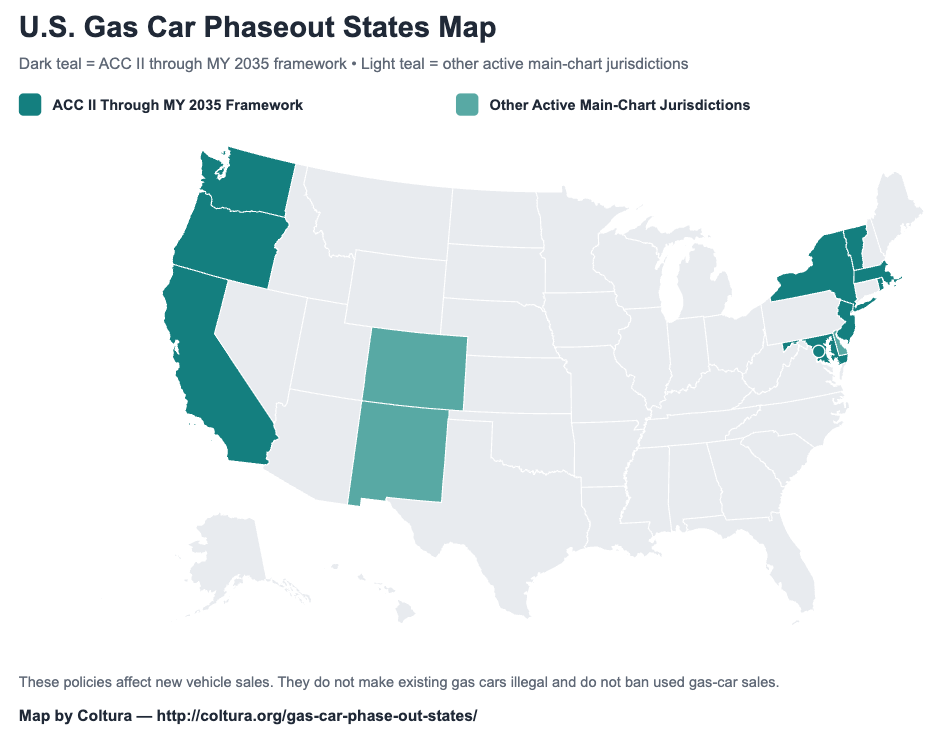
California and a number of other states adopted Advanced Clean Cars II or related California-linked clean-car standards. These policies generally concern new vehicle sales and manufacturer requirements, not gasoline cars people already own.
Their current status is not uniform. Federal preemption litigation, state-specific timelines, and enforcement decisions mean that adopting a 2035 rule does not necessarily mean the requirement is currently being enforced.
For the current list, target years, legal status, and state-by-state source links, read Gas Car “Phase Out” States.
Map note: The map below shows states and jurisdictions that adopted California-linked or related clean-car standards. Adoption does not necessarily mean every requirement is currently enforceable; federal litigation and state implementation decisions continue to affect the 2026 status.
Gasoline Superuser Approach
While state-level standards help ensure an eventual end to gasoline use, they don’t cut gasoline use fast enough on their own. To maximize gasoline reduction, we must help those drivers using the most gasoline (“Gasoline Superusers”) switch to EVs as soon as possible.
Across the US, Gasoline Superusers are using about one-third of all the gasoline — often because they must commute long distances between affordable housing and jobs. Learn more about Coltura’s gasoline superuser approach.
Coltura’s report, "Country Crossroads," published in 2024, sheds light on rural Gasoline Superusers — a small subset of rural drivers who, despite comprising less than 4% of the US population, account for nearly 13% of the nation's gasoline consumption.
Learn from our free webinar about how the gasoline superuser approach can help reduce vehicle emissions faster and more equitably.
Learn more about the life cycle harms of gasoline.
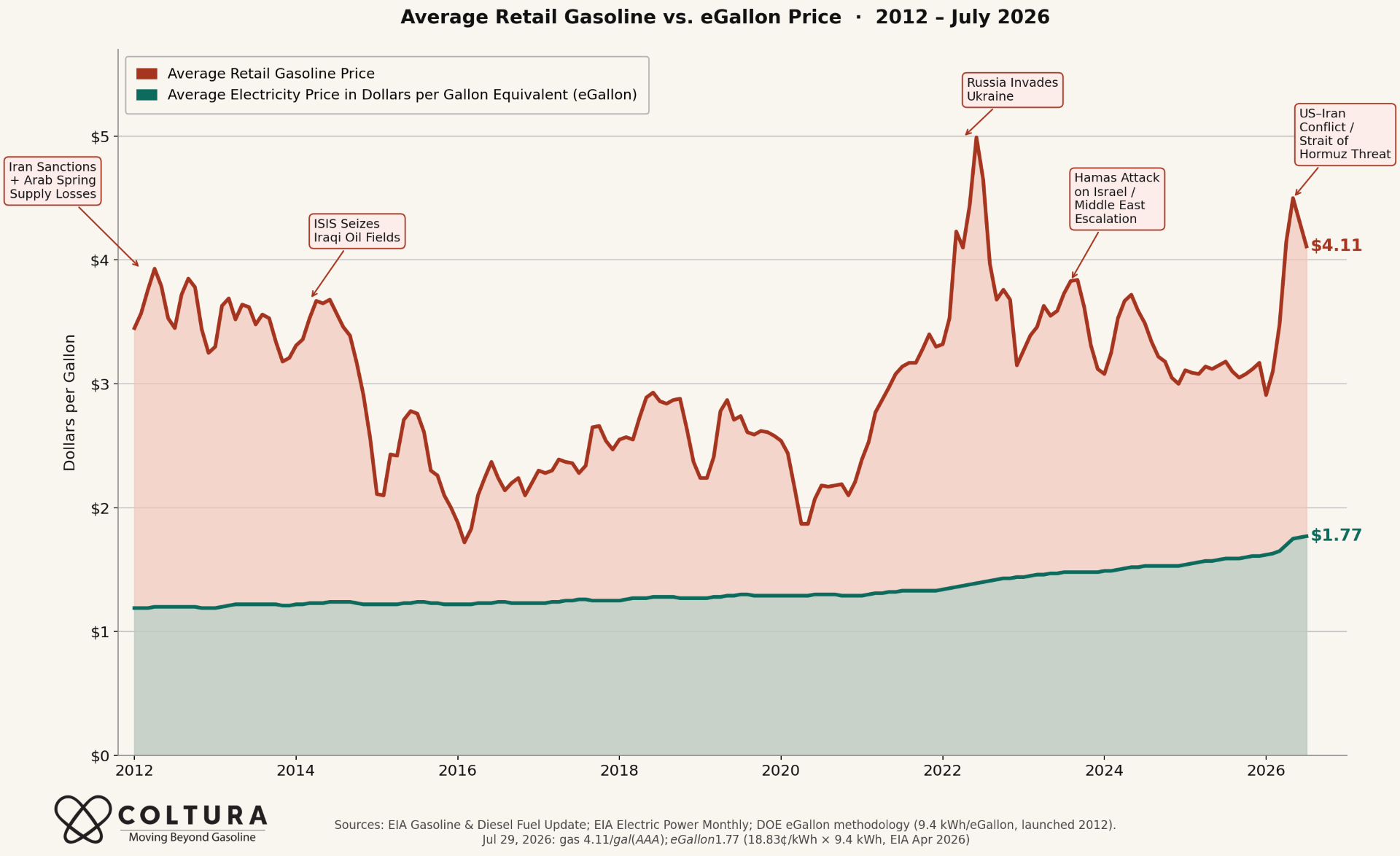
Average U.S. Gasoline Prices Have Been Far More Volatile Than eGallon Electricity Costs
Gasoline costs are another reason many drivers compare gasoline vehicles with EVs. This Coltura chart compares monthly average U.S. retail gasoline prices with a residential electricity eGallon estimate, showing how gasoline prices have fluctuated much more sharply while estimated electricity costs have remained comparatively stable.
Interested in a more updated and interactive version of the above chart? Check out Coltura's EV Cost Savings Index
Pollution Ends Where Action Begins
For over a decade, Coltura has been leading the movement to move America beyond gasoline — turning complex policy, data, and real-world trends into clear, actionable insight.
Join thousands of people learning, sharing, and helping move America toward cleaner, more affordable transportation.
Sign up to get monthly news and inspiration from our award-winning nonprofit and the Beyond Gasoline Movement.
Curious how much you might save by switching to an EV? Get a quick estimate of your fuel & maintenance savings below.
*Disclaimer: This tool is only intended to provide an estimate of potential savings. Actual results will vary. Learn more about the calculation and the Electric vs Gas Calculator here.