


 The California Ban On Gas Cars — What You Need To Know In 2026
This is about new car sales — not taking existing gas cars off the road.

California’s “gas car ban” is shorthand for Advanced Clean Cars II (ACC II), a rule California adopted to phase out sales of new gasoline-only passenger cars and light trucks by 2035. In 2035, automakers were meant to meet a 100% “zero-emission vehicle” (ZEV) sales requirement.
It does not ban owning, driving, or selling used gas cars. Common question: Are gas cars banned in California? No — you can still own and drive gas cars, and used gas cars can still be bought and sold.
Important 2026 update: the ACC II sales schedule is not currently being enforced as a mandatory requirement while California challenges the federal government’s 2025 action against the EPA waiver that allowed the state to enforce ACC II. CARB has kept its earlier vehicle-emissions standards in place during the litigation.
In This Article
- California’s gas car ban overview
- When are gas cars banned in California? (Timeline to 2035)
- Is California’s gas car ban blocked in 2026?
- Incentives in California promoting electric vehicle adoption
- Other states following California’s lead
- Why is there a gas car ban in California?
- FAQ: California ban on gas cars
- Gasoline Superuser approach note
CA "Gas Car Ban" Status In 2026
- 2020: Governor Newsom’s Executive Order N-79-20 directed the state toward 100% new ZEV sales by 2035 and made clear the policy concerns new sales, not existing cars.
- 2022: CARB adopted Advanced Clean Cars II (ACC II), creating the adopted year-by-year schedule that reaches 100% qualifying ZEV sales in 2035.
- December 2024: EPA granted California a Clean Air Act waiver of preemption for ACC II. The notice was published in the Federal Register on January 6, 2025.
- March 6, 2025: The U.S. Government Accountability Office (GAO) issued a legal decision stating that these waiver notices are not “rules” under the Congressional Review Act (CRA).
- June 12, 2025: President Trump signed a CRA joint resolution stating that the ACC II waiver notice “shall have no force or effect” (see H.J.Res. 88). California and ten other states sued, arguing the disapproval was unlawful.
- March 26, 2026: CARB approved permanent fallback vehicle-emissions regulations clarifying that California’s earlier standards remain in place while the federal dispute over ACC II is litigated. Manufacturers may voluntarily comply with ACC II.
- August 2026: The lawsuit remains unresolved. The federal court heard the government’s motion to dismiss on February 19, 2026 and allowed limited supplemental briefing in August after the Supreme Court’s decision in Mullin v. Doe. See the August 13, 2026 court order.
California’s "Gas Car Ban" Overview
California made history as the first U.S. state to map out a phaseout of new gasoline-only passenger-vehicle sales by 2035. A number of states and the District of Columbia later adopted California clean-car standards, although the exact rules and current enforcement status vary by state. These policies are part of the broader international movement toward diesel and gasoline vehicle phaseouts.
People search “California ban on gas cars” and “California gas car ban” as shorthand — but the policy is really a new-vehicle sales standard for automakers. ACC II sets California’s adopted schedule for how quickly automakers would shift new sales toward zero-emission vehicles (ZEVs).
In 2020, Executive Order N-79-20 from Governor Newsom called for all new passenger vehicles sold in California to be zero emissions by 2035.
In 2022, California’s Advanced Clean Cars II regulations were adopted. ACC II established a year-by-year ZEV sales schedule for automakers beginning with model year 2026 and added durability, warranty, charging and other vehicle requirements.
Under ACC II’s adopted 2035 standard, automakers could meet up to 20% of the ZEV requirement with qualifying plug-in hybrids that have at least 50 miles of all-electric range. CARB summarizes the adopted program in its ACC II adoption release.
Current 2026 status: Because of the federal waiver dispute, the ACC II percentages below should be read as the adopted ACC II schedule, not as sales quotas California is currently enforcing. CARB says its earlier emissions standards remain in place while the litigation proceeds.

When Are Gas Cars Banned In California? (Timeline To 2035)
“Ban” is shorthand. ACC II’s adopted schedule ramps up the share of qualifying new ZEV and plug-in-hybrid sales beginning with model year 2026:
- 2026 model year: ACC II’s adopted schedule calls for 35% of new sales to meet the ZEV requirement.
- 2030 model year: the adopted benchmark rises to 68%.
- 2035 model year: the adopted benchmark reaches 100%, with automakers allowed to meet up to 20% of the requirement with qualifying plug-in hybrids.
2026 enforcement note: The federal government’s 2025 disapproval of the EPA waiver means California is not currently enforcing the ACC II percentage schedule as mandatory. California is challenging that action in court, and CARB has kept earlier vehicle-emissions standards in place during the litigation.
Here is the adopted ACC II timeline for new vehicle sales in California:

Important: The chart shows ACC II’s adopted schedule. It does not show the separate 2025–2026 federal waiver dispute or California’s current fallback to earlier vehicle-emissions standards.
ACC II does not ban owning gas cars, driving gas cars, or buying and selling used gas cars. CARB’s rule applies to new vehicle sales by automakers; existing vehicles remain legal to own and drive.
For the latest program details and compliance categories, refer to CARB’s official Advanced Clean Cars II program page.
Is California’s "Gas Car Ban" Blocked In 2026?
In practical enforcement terms, yes — ACC II’s new ZEV sales percentages are not currently being enforced as mandatory requirements. But ACC II has not simply disappeared from California law, and the legal fight over the federal waiver is still unresolved.
- EPA granted California a waiver for ACC II in December 2024. See EPA’s announcement and the Federal Register notice.
- Congress passed and President Trump signed a CRA resolution stating that the ACC II waiver notice “shall have no force or effect.” See H.J.Res. 88.
- GAO had concluded that Clean Air Act waiver notices are not CRA “rules.” California and ten other states sued, arguing that Congress and the federal government could not lawfully use the CRA this way. See GAO’s March 6, 2025 decision.
- CARB responded by keeping earlier vehicle-emissions standards operative while the case proceeds. On March 26, 2026, CARB approved permanent fallback regulations and said manufacturers may also voluntarily comply with ACC II.
- As of August 30, 2026, the federal court had not resolved the core dispute. The motion to dismiss was argued on February 19, and the court allowed additional August briefing on a later Supreme Court decision. See the August 13 order.
Bottom line: California still has an adopted ACC II policy aiming at a 2035 transition for new vehicle sales, but the specific ACC II mandate is currently blocked from operating as originally planned while the waiver litigation continues.
Incentives In California Promoting Electric Vehicle Adoption
California’s transition to electric vehicles is supported by state, regional and utility incentives. See Coltura’s complete guide to California EV incentives to compare current vehicle rebates, charging assistance and local programs. Here are a few examples:
- South Coast vehicle replacement: Income-qualified residents with an eligible older vehicle may qualify for substantial assistance through South Coast AQMD. Our Replace Your Ride California guide explains the incentive amounts, service area, vehicle requirements, charging support and application process.
- PG&E customers: See the PG&E EV rebate guide for current pre-owned-EV rebates, home-charging assistance, electrical-panel support and EV electricity rates.
- Southern California Edison customers: See the SCE EV rebate guide for its pre-owned-EV rebate, Charge Ready Home assistance, managed-charging rewards and EV rates.
Eligibility, funding and stacking rules vary. Check every applicable program and obtain any required approval before purchasing, leasing or ordering a vehicle.
ACC II also includes warranty requirements for EVs.
- EVs must be warranted to maintain at least 80% of range for 10 years or 150,000 miles by model year 2030 (phased in from 70% for model years 2026–2029).
- Battery packs must be warranted to maintain 75% of their energy for 8 years or 100,000 miles by model year 2031 (phased in from 70% for model years 2026–2030).
- Powertrain components must also be warranted for at least 3 years or 50,000 miles.
Looking To Save Money On An EV in 2026?
Our nonprofit has collected some of the best resources on purchasing or leasing an EV and put them into an easy-to-use cheat sheet.
It’s a must-read for people considering an EV.
Simply enter your email to access the free cheat sheet and receive monthly news and inspiration from our nonprofit.
Other States Following California’s Lead
Under the Clean Air Act, other states can choose to adopt California vehicle-emissions standards. CARB maintains an updated Section 177 states dashboard.
Important 2026 update: adopting a California clean-car standard does not necessarily mean a state is currently enforcing California’s full 2035 ACC II schedule. Some states adopted only part of the timeline, and several states have announced temporary enforcement discretion or pauses while the federal waiver litigation proceeds. Check the CARB dashboard and the relevant state environmental agency for current status.
For example, Delaware and New Mexico adopted ACC II requirements only through model year 2032, while Massachusetts and New York are exercising enforcement discretion for the first two ACC II model years and Washington has temporarily paused portions of its standards.
CARB has noted that California and other states using California vehicle standards together account for roughly 40% of the U.S. new-vehicle market.
Learn more about states with gasoline car bans and phaseouts.
States That Adopted California Clean-Car Standards
Map note: colored states represent adoption of California vehicle standards or related ACC II rules; this should not be read as saying that every colored state currently has an enforceable 100% 2035 sales requirement.
Why Is There A Gas Car Ban In California?
Reducing Air Pollution in California
CARB designed ACC II to cut pollution from light-duty vehicles over time and projected that the rule would reduce smog-causing pollution from new light-duty vehicles by about 25% by 2037.
California continues to have some of the worst air pollution in the country. The American Lung Association’s 2026 State of the Air report ranked Los Angeles–Long Beach as the nation’s most ozone-polluted metro and Bakersfield as the most polluted for annual particle pollution.
Motor vehicles and engines remain a major source of California’s smog-forming and toxic air pollution. CARB’s 2026 vehicle-emissions update says they are the state’s largest single contributor of those pollutants.
Reducing Carbon Emissions In California
California is working to reduce carbon emissions by shifting transportation away from gasoline and toward cleaner alternatives.
The transportation sector remains California’s largest source of greenhouse gas emissions. CARB’s current 2000–2023 greenhouse gas inventory reports transportation at about 37% of statewide emissions in 2023. Passenger vehicles alone accounted for roughly 28% of statewide emissions.

Gasoline Superuser Approach Note
New vehicle sales are only a small share of all vehicles on the road in any given year. Even if new sales shift quickly, many older gas cars will remain on the road for years.
To cut gasoline use faster, we must help the drivers using the most gasoline (“Gasoline Superusers”) switch to EVs as soon as possible. Coltura’s research estimates Gasoline Superusers use roughly one-third of all gasoline across U.S. light-duty vehicles — often because they must commute long distances between affordable housing and jobs.
Learn more about Coltura’s gasoline superuser approach.
Update: AB 2401 (2024) was vetoed. If you want to learn about the policy idea and why it mattered for equity-focused EV adoption, see CARB’s page: AB 2401 (vetoed) — background and veto message.
FAQ: California Ban On Gas Cars
Are gas cars banned in California?
No. California’s policy concerns new vehicle sales by automakers. It does not ban owning or driving existing gas cars, and it does not stop the sale of used gas cars. ACC II’s specific sales percentages are also not currently being enforced as mandatory requirements while the federal waiver dispute is in court.
When are gas cars banned in California?
“Banned” is shorthand. ACC II’s adopted schedule begins with model year 2026 and reaches a 100% qualifying ZEV requirement by model year 2035. But the ACC II schedule is not currently being enforced as mandatory because of the federal waiver dispute.
Is California banning gas cars in 2030?
Not outright. Under ACC II’s adopted schedule, the model year 2030 benchmark is 68% of new sales meeting the ZEV requirement. The current federal dispute means that benchmark should not be described as a presently enforceable quota.
Can I still drive my gas car after 2035?
Yes. California’s ACC II policy does not make an existing gasoline car illegal in 2035. You can continue to own and drive a gas car, and used gasoline cars can still be bought and sold. The 2035 policy concerns qualifying new vehicle sales by automakers.
Can you buy a gas car in California after 2035?
You can still buy and sell used gas cars after 2035. Under ACC II’s adopted schedule, the 2035 requirement applies to new vehicle sales — and automakers may meet up to 20% of the adopted requirement with qualifying plug-in hybrids. Whether that schedule is enforceable will depend on the outcome of the federal litigation unless the legal landscape changes before then.
What is California’s electric car law or EV mandate?
Those phrases usually refer to Advanced Clean Cars II (ACC II), the 2022 California regulation that set an adopted ZEV sales schedule of 35% for model year 2026, 68% for 2030 and 100% for 2035. In 2026, however, the ACC II percentages are not being enforced as mandatory while California challenges the federal action against its EPA waiver.
What cars are banned in California (is it all cars)?
The adopted ACC II rule is focused on new passenger cars and light-duty trucks sold by automakers. It does not apply to every vehicle category, and it does not make existing vehicles illegal to own or drive.
Is California’s gas car ban blocked?
The ACC II mandate is currently blocked from being enforced as originally planned, but the underlying California regulation has not simply been repealed. EPA granted a waiver in December 2024; Congress and President Trump used the CRA in 2025 to state that the waiver has no force or effect; and California and ten other states sued. CARB is using earlier vehicle-emissions standards while the litigation continues. As of August 30, 2026, the court had not resolved the central dispute.
Average U.S. Gasoline Prices Have Been Far More Volatile Than eGallon Electricity Costs
Americans use enormous amounts of gasoline, and that leaves households exposed whenever oil markets swing. This Coltura chart compares monthly average U.S. retail gasoline prices with an electricity eGallon price estimate. It helps show why reducing gasoline consumption matters so much: electricity has been far less volatile over time.
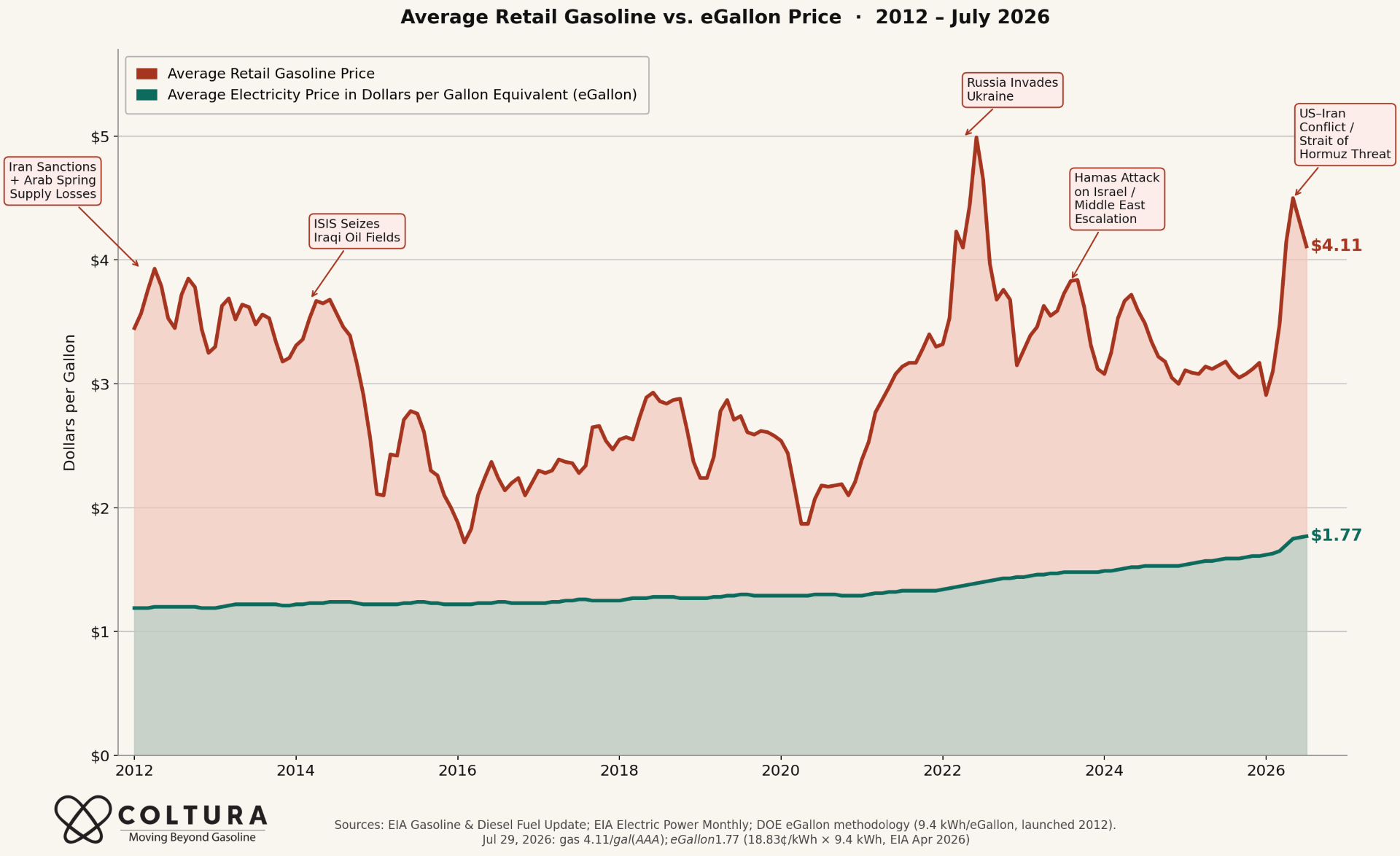
Interested in a more updated and interactive version of the above chart? Check out Coltura's EV Cost Savings Index

Join Coltura
Coltura works to improve climate, health, and equity by accelerating the transition from gasoline to cleaner, cheaper alternatives.
Take the next step! Sign up to get news, inspiration, and info from Coltura and the Beyond Gasoline Movement.

Curious how much you could save switching to an EV? Get a quick estimate of your fuel & maintenance savings below!
*Disclaimer: This tool is only intended to provide an estimate of potential savings. Actual results will vary. Learn more about the calculation and the Electric vs Gas Calculator here.