

Gasoline Phaseout News – March 2026
The Iran War Is About Oil. EVs Can Help.

The current Iran war is a stark reminder that our dependence on oil is not only military and geopolitical, but also economic, democratic and environmental. The fossil fuel industry has poured vast sums into climate denial, lobbying, and campaigns to discredit alternatives. As green technologies have threatened their dominance, their grip on governments and media has tightened. The result is a global democratic recession driven in significant part by fossil fuel interests, leaders selected for their willingness to keep hydrocarbons flowing, regardless of the cost to democracy itself.
The Pentagon is seeking $200 billion from Congress just to continue this war. Princeton researchers estimate the entire additional cost of getting the U.S. to net zero by 2050 is roughly $300 billion. One buys us nothing. The other buys us energy independence and a better chance at a livable planet.
Coltura’s work starts from a simple insight: the fastest path out of this trap runs through our driveways. The top 10% of American drivers by gas consumption account for 35% of the nation’s gasoline use. Helping those drivers switch to EVs, especially as affordable used models flood the market, saves them thousands of dollars a year and chips away at the demand that makes oil so politically powerful.
Globally, in 2025 EVs avoided 1.7 million barrels of oil/day, equivalent to 70% of what Iran exports through the Strait of Hormuz. Greener, cheaper, more secure, and free from the next war over oil: switching to an EV is one of the most concrete things any American family can do to stop funding the next crisis before it starts.
Used EVs: A Shield Against the Gas Price Spike
Average U.S. gasoline prices have surged more than $1.00 a gallon since the Iran war began on February 28, with no clear end in sight. The good news: the used EV market has never looked better as a way out.
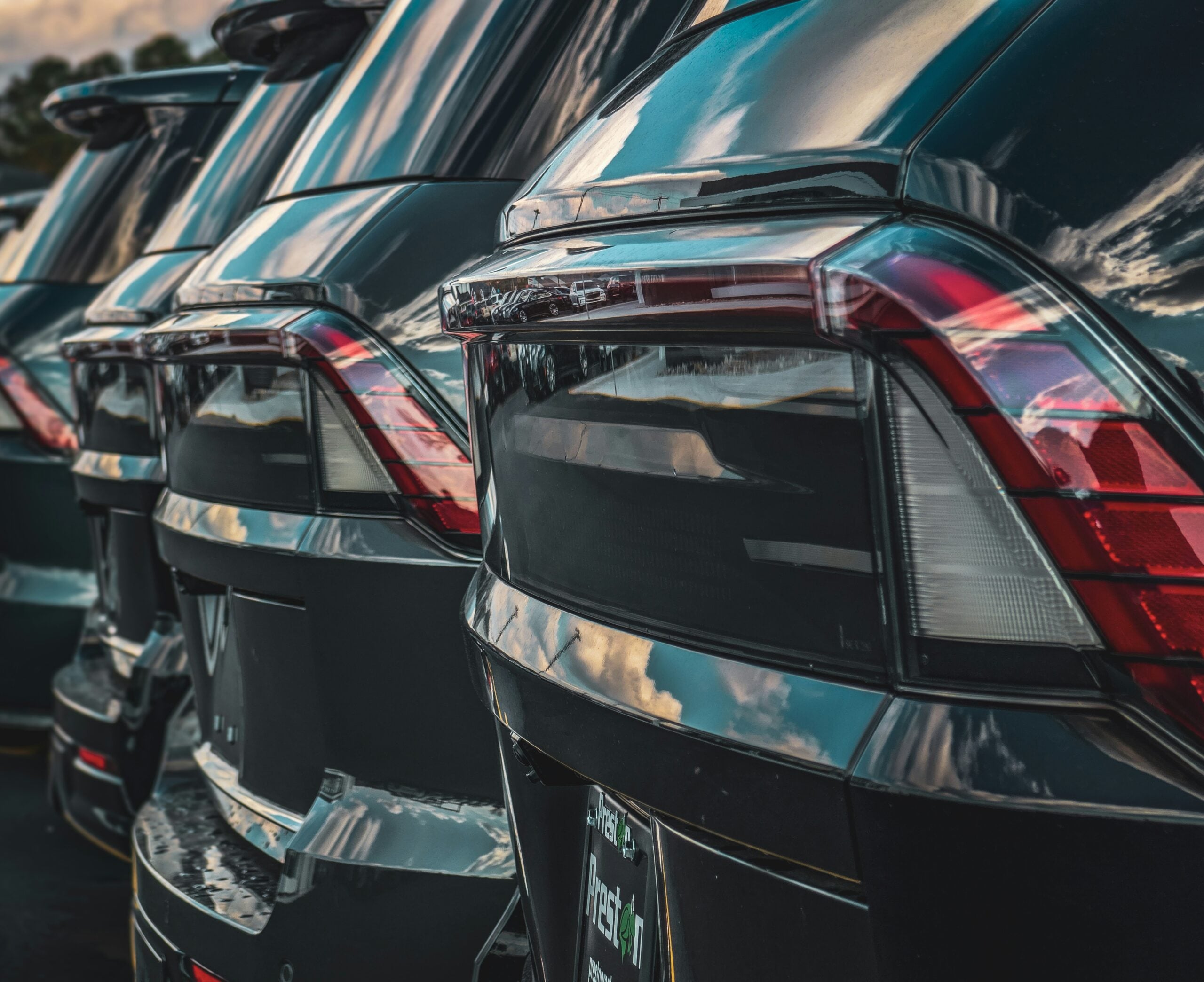
The supply of used EVs has tripled from 2024 to 2026, with 200,000 EVs coming off lease this year. And the deals right now are remarkable. A loaded 2024 Chevy Blazer EV now trades for as little as $25,000. Tesla Model 3s and Chevy Bolts can be found for $15,000, with base Ioniq 5s and Kona EVs near $20,000. And if you have $35,000, you can get a Cadillac Lyriq or BMW i4. A well-equipped 2023 Chevy Bolt EUV with under 15,000 miles can be had for around $18,000. For driving around town, there are $5,000 to $10,000 Nissan Leaf and BMW i3 models with up to 150 miles of range.
Gasoline is a global commodity, hostage to events halfway around the world. Electricity is local, stable, and cheap. The Strait of Hormuz won’t determine your electric bill. Especially for the people who drive the most and are being hammered by current gas prices, used EVs just make sense.
Data Insight of the Month:
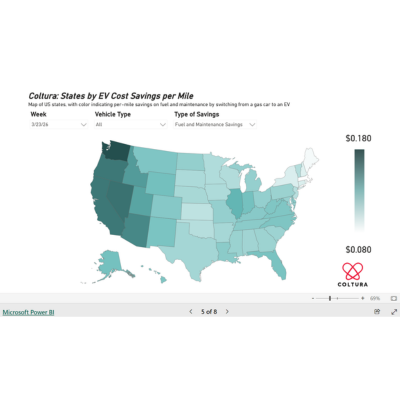
EV Cost Savings, Updated Weekly
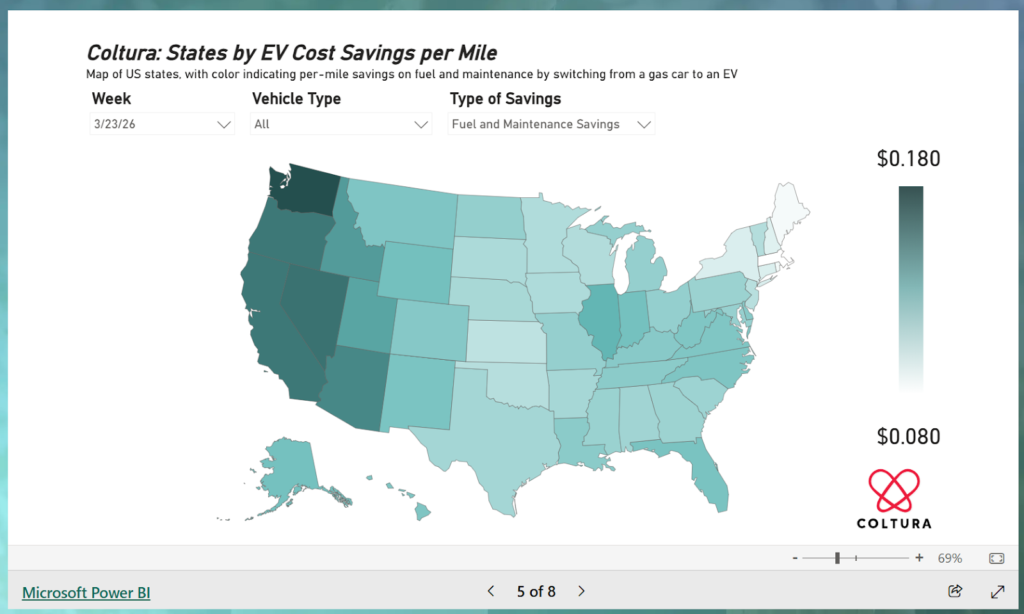
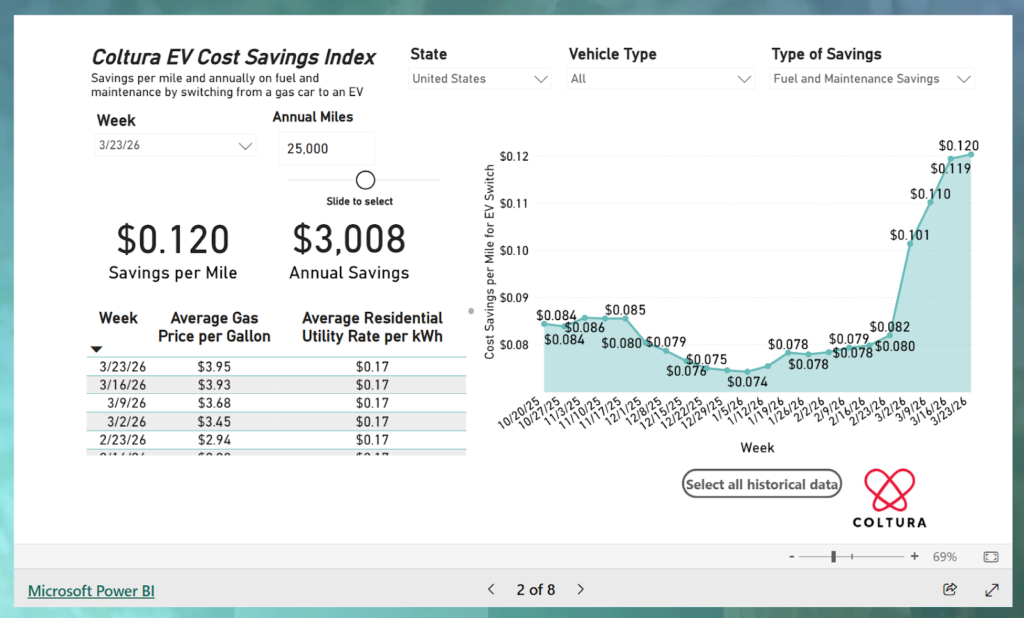

With gas prices rising daily, Coltura’s EV Cost Savings Index, updated weekly, lets drivers see their savings per mile, per trip, per month or per year from switching to an EV. Input your state and annual mileage for your personalized savings. Of course, the more you drive, the more you save by going electric – while also insulating yourself from gasoline price spikes every time there’s another oil conflict. Learn more here.
Why Your Support Has Never Mattered More
Gas prices have spiked a dollar per gallon since last month. For most Americans, that’s an inconvenience. For millions of families already spending 15% or more of their income on gasoline, disproportionately Black, Latino, and rural drivers with long commutes, it’s a crisis on top of a crisis.
Coltura exists to help get these families into EVs. Not someday. Now.
We do the data work that makes targeted EV programs possible. We push the policies that direct incentives to the drivers who need them most. And we build the tools that help high-mileage drivers find affordable used EVs and calculate exactly how much they’d save.
The Iran war is a reminder of what gasoline dependence really costs — and who pays the highest price.
Please donate today. Your support helps us fight for the families most trapped by the pump.
Pinole, California Unanimously Bans New Gas Stations
City in the heart of refinery territory takes a bold stand By Woody Hastings
The Pinole, California City Council has voted unanimously to permanently prohibit the construction of new gasoline stations and the expansion of existing ones.
Pinole, a city of about 20,000 in Contra Costa County and home to four transportation fuel refineries, sits at the heart of Bay Area refinery country, making this local vote especially significant.
“This decision supports more alternative fuel options for the community and visitors to choose from and helps advance our Climate Action and Adaptation Plan goals for cleaner transportation and a more equitable, sustainable, and resilient community” said Kapil Amin, Sustainability Project Manager for the City of Pinole Community Development Department.
The ordinance was the result of two years of community engagement, Planning Commission hearings, and a moratorium on new gas stations first adopted in 2024.
Pinole joins roughly 13 cities in Sonoma, Marin, and Napa counties, plus Sonoma County itself, that have adopted similar bans since Petaluma pioneered the policy in 2021. Read more on gas station harms and bans here.
Woody Hastings coordinates the Coalition Opposing New Gas Stations (CONGAS), founded in Sonoma County in 2019.
Gas Stations Are More Harmful Than You Think
A growing movement to ban new gas station construction is gaining momentum across the country — from Petaluma’s pioneering 2021 ordinance to recent actions in Ohio, New York, Colorado, and the Bay Area. And the case against building more of them is stronger than most people realize.
The harms operate on every level. As Coltura co-executive director Janelle London explains: “Above ground, on the ground, and below the ground, there are toxins at every level.” Small spills happen at nearly every fill-up, and those drops accumulate in soil and waterways over time — contributing to elevated cancer rates among nearby residents and station workers alike. Add in broader economic costs and climate impacts, and gas stations represent infrastructure we can’t afford to keep expanding.
Banning new construction won’t eliminate existing stations overnight, but it sends an unmistakable signal. As London says, “If we banned the construction of new gas stations, it would start sending the message that the future is not gasoline.”
Coltura’s research is featured in a recent Sierra Club magazine piece on this movement — read it here.
Gas Station of the Month:
A&A Gas & Mart, Burlingame, CA
Gasoline leaking from underground tanks at the A&A Gas & Mart seeped into an AT&T electrical vault and then a PG&E vault a week later, knocking out power and shutting down streets for more than a week.
As a result, nearly 100 small businesses along the Broadway Corridor lost thousands of dollars each. Their class action lawsuit points to roughly two dozen underground tank violations at the station over the years. “The tanks were so old,” said the plaintiffs’ attorney. “They knew there was a potential for a leak.”
Want more stories like these in your inbox? Sign up below for your free subscription to Gasoline Phaseout News!
Culture Corner:
Even the Petrol-Heads Are Shopping Electric
For decades, the American car culture divide seemed fixed: EV drivers were environmentalists, gas drivers were everyone else.
The Iran war may be changing that.
Michael Prichinello is the cofounder of Manhattan’s Classic Car Club and by his own description, one of the world’s biggest petrol-heads. He has spent years behind the wheel of the world’s most precious and thirstiest sports cars. He is now shopping for an electric pickup truck. “Begrudgingly,” he says. His daily commute in a full-sized Silverado has stretched his gas bill to $50 a day. “She’s a gem and I’ll never get rid of her,” he says of the Silverado. “But it feels irresponsible.”
EV search traffic jumped 20% in the first week of the Iran conflict, with interest in the Tesla Model Y and Chevrolet Equinox nearly doubling.
When the guy running the Classic Car Club starts shopping electric, something cultural has shifted.