Gasoline Phaseout News – January 2026
Time to Move Beyond Venezuela and Other Oil Conflicts
As the United States tries to control Venezuela’s oil reserves through diplomatic pressure, sanctions, and military operations, it is worth asking a basic question: why are we fighting in the twenty-first century over a twentieth-century fuel? Chasing additional barrels of oil abroad does little to protect American households from volatile gasoline prices or to strengthen long-term energy security.
Gasoline ties the U.S. economy to a global commodity market shaped by geopolitics, instability, and forces well beyond our control. Even when new supplies come online, history shows that the relief at the pump is limited and short-lived. What lasts much longer are the consequences: higher emissions, continued exposure to gasoline price shocks, and infrastructure investments that lock in gasoline dependence for decades.
If we continue to frame energy security as a question of oil supply, we will remain vulnerable—economically, environmentally, and geopolitically.
At Coltura, we focus on the demand side of the equation, advancing policies and tools to cut gasoline demand at speed and scale. Reducing gasoline use, especially by prioritizing switching the highest-consuming drivers to EVs, can deliver faster, more durable benefits than expanding oil access ever could. Cutting gasoline demand lowers emissions, reduces household fuel costs, and weakens the leverage of volatile global oil markets over American families.
The path forward does not require more oil diplomacy or riskier extraction. It requires a deliberate shift away from gasoline itself.
Coltura Testifies Against Trump Rollback of Fuel Economy Rules
On January 7th, Coltura’s Rob Sargent presented testimony to the National Highway Traffic Safety Administration (NHTSA), calling on them to back off on their plan to rollback fuel economy standards.
“The proposed rule would increase consumer fuel costs, reduce effective vehicle choice, weaken incentives for technological innovation, and increase national gasoline consumption, all while setting standards below levels the industry has already achieved. For the sake of American consumers, our global economic competitiveness, our health, and the planet, I urge NHTSA to withdraw this rule and maintain fuel economy standards that reflect technological feasibility, drive industry innovation, and reduce unnecessary fuel expenditures,” said Sargent.
See Coltura’s written testimony here.
Coltura’s EV Cost Savings Index Shows Savings on Fuel and Maintenance in Every State
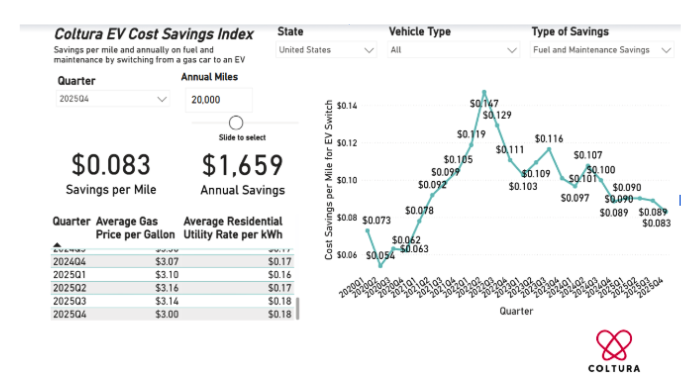
Coltura’s newly released quarterly EV Cost Savings Index reports that, even with lower gasoline prices, EV drivers across the U.S. are saving an average 8.3 cents per mile on fuel and maintenance compared with gas cars. Fuel savings alone for EVs are on average 5.3 cents/mile relative to gas cars.
People who drive the most stand to save the most by switching from a gas car to an EV. U.S. drivers driving 20,000 miles/year can save an average of $1,659/year on fuel and maintenance, and $1,059 on fuel alone.
The savings in every state varies greatly depending on local electric rates and gasoline prices, ranging from 13.4 cents/mile in Washington State to 4.9 cents/mile in Massachusetts.
EV cost savings declined slightly since Q1 2025 due to a combination of higher electric rates and lower gas prices. Average retail electric rates in the U.S. have increased 12.5% since Q1 while average U.S. gasoline prices declined 3.3%.
Explore how much drivers in your state could save at data.coltura.org/ev-savings-index.
New Research Shows EVs Are Cutting Air Pollution
A new California study now offers real-world evidence that EVs are reducing air pollution and benefiting public health. Researchers analyzed data from 2019–2023 across nearly 1,700 California neighborhoods, pairing EV registration data with satellite air-quality measurements. They found that for every 200 additional EVs added in a neighborhood, annual average nitrogen dioxide (NO₂) levels dropped about 1.1%, a clear sign that EV adoption is already cleaning local air.
The research used high-resolution satellite data to ensure broad coverage beyond ground sensors and controlled for changing gas prices and pandemic impacts. Neighborhoods with more gas-powered cars saw expected pollution rises.
NO₂, a harmful byproduct of fossil fuel combustion, is tied to asthma, bronchitis, heart disease and stroke, so even modest declines can have meaningful health effects. As EV numbers grow, these environmental and health benefits are poised to expand further.
Laying the Groundwork for a High-Impact EV Pilot
In Q4 2025, your support and a generous matching challenge raised $70,000 toward Coltura’s proposed pilot to test a powerful idea: that targeted outreach to the biggest gasoline users with a focus on the cost savings of EVs can increase EV adoption at far lower cost than traditional government subsidies.
This early funding provides two critical things: validation of the approach and leverage to move the work forward strategically.
While $70,000 is not sufficient to execute the full pilot at the scale required, it positions Coltura to engage partners and co-funders to launch a pilot large enough to meaningfully inform policy and investment decisions.
We’re excited about the momentum behind this work and grateful for your generous support!
Gas Station of the Month:
Circle K in Nashville
A fuel tanker was leaving the Circle K gas station on Gallatin Pike in East Nashville, TN when it hit an obstacle that ruptured a valve, spilling thousands of gallons of gasoline. The fuel spill reached several storm drains which feed into a nearby creek. Nashville Fire crews used damming and dyking techniques to contain the fuel and prevent any further runoff. The pike and surrounding areas were closed.
Want more stories like these in your inbox? Sign up below for your free subscription to Gasoline Phaseout News!
Culture Corner:
Republican Attitudes on EVs May Be Shifting
Republican opposition to electric vehicles may be softening as the 2024 election fades, according to a new poll of 600 voters conducted by Hill Research Consultants. The survey, commissioned by the American EV Jobs Alliance and EVs for All America, suggests GOP voters are becoming more open to EVs in a less charged political climate. Growing EV-related jobs and investment in conservative states may be causing the change in Republican attitudes.