


 How Long Does It Take To Charge An Electric Car In 2026?
Use our charging time estimator and practical guide to EV charging time at home, at public stations, and on road trips.
Last updated: May, 2026

“How long does it take to charge an electric car?” is one of the first questions many people ask before switching to an EV.
On one end of the spectrum, a modern DC fast charger can add a large amount of range during a quick coffee or lunch stop. On the other, a standard wall outlet may take more than a day to recharge a large battery from nearly empty. But for most EV owners, daily charging rarely feels like standing around waiting for the battery to fill up.
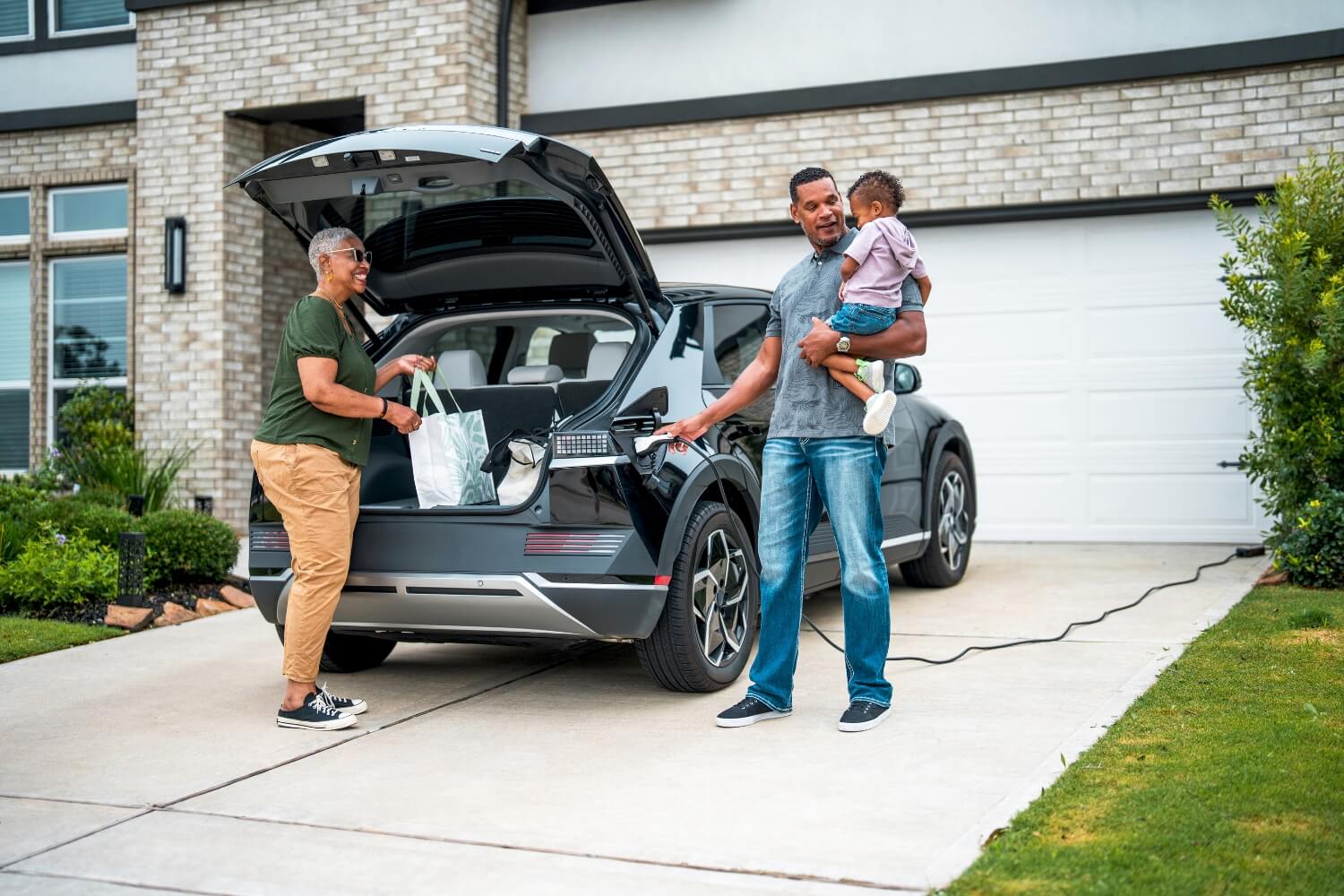
That is because EV charging usually happens in the background of everyday life. The car charges while you sleep, work, shop, eat dinner, watch a movie, or take a break on a road trip.
Instead of making a dedicated stop at a gas station every week, many drivers gradually add range throughout the day or overnight.
In 2026, EV charging is also changing quickly. Public fast-charging networks continue expanding, more vehicles can charge at higher speeds, and many automakers are moving toward broader compatibility. At the same time, the basics still matter: charger type, battery size, temperature, and charging speed limits all affect how long charging actually takes.
This guide breaks down real-world electric car charging times by charger type — Level 1, Level 2, and DC fast charging — plus the biggest factors that affect charging speed, from battery size and temperature to the 80% charging slowdown.
Quick Answer: How Long Does It Take To Charge An Electric Car?
Charging an electric car can take about 20 minutes to more than 40 hours, depending on the charger type, battery size, vehicle charging speed, temperature, and how much range you need.
- Level 1 charging: A regular 120-volt outlet is slow. It often adds only a few miles of range per hour and can take 40–50+ hours to charge a battery-electric vehicle to 80% from empty.
- Level 2 charging: Common at homes, workplaces, hotels, garages, and public lots. It often takes 4–10 hours to charge a typical battery-electric vehicle to 80% from empty, though large batteries or lower-power setups can take longer.
- DC fast charging: The fastest public option. It can often charge an EV to about 80% in 20–60 minutes, depending on the vehicle, charger power, temperature, and battery state of charge.
The practical answer: Most EV drivers do not wait for an empty-to-full charge. They top up while parked or use DC fast charging to add enough range for the next leg of a trip.
Sources: U.S. Department of Transportation charger speed guidance and Alternative Fuels Data Center public charging guidance.
Related Guides From Our Nonprofit
- Drive or shop Tesla? Jump to our section on how long it takes to charge a Tesla in 2026.
- Find a charger near you: Find EV Charging Stations Near Me: 3 Best Apps
- Looking for free options? Free EV Charging Stations Near You: Find Them In 2026
- Charging at home? EV Home Charging Overview: Convenient And Affordable
- Shopping for an EV? Use Our EV Savings Calculator
Disclaimer: Charging times are estimates. Always follow your automaker’s charging guidance, owner’s manual, battery-care recommendations, and adapter instructions.

In This Article
- What Changed For EV Charging In 2026?
- Electric Car Charging Time Chart
- Why EV Charging Time Varies
- How To Estimate Your Charging Time
- How Long Level 1 Charging Takes
- How Long Level 2 Charging Takes
- How Long DC Fast Charging Takes
- How Long It Takes At A Charging Station
- What Charging Feels Like In Real Life
- Example EV Charging Times
- How Long Does It Take To Charge A Tesla
- EV Charging Tips
- Sources And Methodology
- EV Charging Time FAQ
Quick EV Charging Estimate
How Long Would It Take To Add Range?
Use this beginner-friendly estimator for a quick ballpark. It keeps the inputs simple, but lets you adjust for charger type, vehicle efficiency, weather, and whether you are charging near the top of the battery.
Try 50 for a small top-off, 100 for a useful boost, or 200 for a longer road-trip charge.
Level 2 is the common park-for-a-while option at home, work, hotels, garages, and many public locations.
Enter charger power in kW. You can find this in the charging app, station screen, or charger specs.
For a more specific efficiency number, search your model on FuelEconomy.gov and look for kWh/100 miles.
Quick estimate
Calculating...
Adjust the inputs to estimate charging time.
Helpful sources: U.S. DOT charging speeds, AFDC charging overview, EPA charging basics, and FuelEconomy.gov.
Need a charger speed? Check the charging network app, station screen, or AFDC station locator.

Looking To Save Money On An EV in 2026?
Our nonprofit has collected some of the best resources on purchasing or leasing an EV and put them into an easy-to-use cheat sheet.
It’s a must-read for people considering an EV.
Simply enter your email to access the free cheat sheet and receive monthly news and inspiration from our nonprofit.

How Long Does Level 1 Charging Take?
Level 1 charging uses a standard 120-volt household outlet. It is the slowest way to charge an electric car, but it can still work for some drivers who have short daily trips and plenty of time to plug in.
DOT notes that Level 1 charging can take 40–50+ hours to charge some battery-electric vehicles to 80% from empty. That sounds intimidating, but many Level 1 users are not charging from empty. They are adding a smaller amount of range overnight.
Level 1 may be enough if you drive only a small number of miles per day, can plug in consistently, and do not need fast recovery after long trips. If you regularly drive longer distances, Level 2 charging is usually a better fit.
How Long Does Level 2 Charging Take?
Level 2 charging is the most common everyday charging solution for many EV owners. It uses a higher-powered 208-volt or 240-volt connection and is common at homes, workplaces, hotels, parking garages, and public destinations.
Level 2 often takes 4–10 hours to charge an EV to 80%, depending on the car and charger. In everyday home charging, many sessions are shorter because the driver is only replacing the miles used that day.
This is why Level 2 is so useful at home. The car can charge while you sleep, and you do not need to stand beside it. DOE notes that about 80% of EV charging happens at home, which helps explain why many EV drivers use public fast charging mainly for road trips or unusual high-mileage days. Source: DOE National EV Charging Network.
How Long Does DC Fast Charging Take?
DC fast charging is the quickest way to charge an electric car and is the main charging type used for long road trips. A common real-world expectation is 20–60 minutes to reach about 80%, depending on the vehicle, charger, battery temperature, and starting charge level.
AFDC notes that DC fast charging can add approximately 100–200+ miles of range in 30 minutes, depending on the vehicle and charger. That is why many road-trip stops are closer to a coffee, restroom, or meal break than an all-day wait. Source: Alternative Fuels Data Center charging station guidance.
The important caveat is that DC fast charging slows down as the battery fills. Many drivers stop around 70–80% on road trips because the final stretch from 80% to 100% can take disproportionately longer. Some older or slower-charging EVs may also take closer to an hour for a meaningful fast-charge stop.
How Long Does It Take To Charge An Electric Car At The Station?
At a public charging station, charging time depends first on whether the station is Level 2 or DC fast charging. Some drivers call these stations charge points; the same time rules apply — check whether the charge point is Level 2 or DC fast before assuming it will be quick.
- Public Level 2 charge point: Often several hours. Best for shopping, work, hotels, garages, or long parked time.
- Public DC fast charge point: Often 20–60 minutes to about 80%. Best for road trips and quick top-ups.
- Busy or unreliable station: Add time for waiting, payment issues, charger errors, or trying another stall.
For road trips, the fastest strategy is often to add enough range to reach your next stop comfortably rather than charging to 100% every time.
EV Charging vs. Filling Up With Gas: A Better Way To Compare Time
Filling a gas tank is usually faster than a public EV charging stop if you compare only the minutes spent at the pump. But EV charging often works differently — and that difference can be a benefit.
With an electric car, much of the “fueling” can happen while you are already doing something else: sleeping at home, working, shopping, eating, or taking a road-trip break. Instead of making a separate stop at a gas station, many EV drivers plug in during parked time and start the next day with the range they need.
On road trips, DC fast charging usually takes longer than pumping gas, but the stop can overlap with bathrooms, coffee, lunch, stretching, walking the dog, or checking messages. For everyday driving, the bigger advantage is that home charging can remove routine gas station trips entirely.
Want to compare more than time? Use our EV Savings Calculator below to estimate how much money you could save by switching from gasoline to electricity.
Haven't switched to an EV yet?
Imagine never having to visit a gas station again, or needing an oil change again or worrying about unpredictable gas prices. With an electric vehicle, this could be your reality—while potentially saving thousands of dollars a year.
Curious how much you could save switching to an EV? Get a quick estimate of your savings below!
*Disclaimer: This tool is only intended to provide an estimate of potential savings. Actual results will vary. Learn more about the calculation and the Electric vs Gas Calculator here.
What Charging Feels Like In Real Life
Three Common EV Charging Routines
- Daily driver with home charging: Plug in overnight a few times a week or every night, depending on driving habits.
- Road tripper: Stop for about 20–40 minutes every few hours, often during bathrooms, food, coffee, or walking breaks.
- Apartment or renter relying on public charging: Build a routine around reliable Level 2 stations, workplace charging, or occasional DC fast charging.
This is the biggest difference between EV charging and gasoline. EV charging is not always a separate errand. It often happens during time when the car would already be parked.

A Sampling Of Time It Takes To Charge Different EVs
Updated for 2026: many new EVs can add meaningful road-trip range during a short DC fast-charging stop, but the exact time depends on the vehicle, charger, battery temperature, starting battery percentage, and charging curve.
This chart is a sampling of popular electric vehicles, not a ranking of every EV on the market. It is meant to help shoppers understand the difference between daily charging and road-trip fast charging. Most drivers do much of their charging while parked at home, work, stores, hotels, or other destinations.
How to read the EPA 240V column: 240V usually means Level 2 charging, the kind many people use at home, work, hotels, stores, and other destinations. The “EPA 240V miles per hour” number is calculated from EPA range divided by EPA 240V charge time. In plain English, it estimates about how many miles of range the vehicle can add in one hour on 240V charging.
How to read the fast-charging reference: DC fast charging is different from 240V Level 2 charging. It is the faster public charging many drivers use on road trips. Automakers report fast charging in different ways, so these references are useful for context but are not perfectly apples-to-apples.
| Vehicle | Starting MSRP | EPA Range | MPGe | EPA 240V Miles Per Hour | Fast-Charging Reference |
|---|---|---|---|---|---|
| Tesla Model Y Long Range RWD 2026 EPA row | $44,990 | 357 mi | 125 | 38.8 mi/hr | Tesla lists up to 182 miles added in 15 minutes on a Supercharger for a Model Y configuration. |
| Tesla Model 3 RWD Long Range 2026 EPA row; Tesla marketing may use Premium RWD naming | $42,490 | 363 mi | 134 | 41.3 mi/hr | Tesla lists up to 195 miles added in 15 minutes at a Supercharger. |
| Chevrolet Equinox EV FWD 2026 EPA row | $33,600 | 319 mi | 108 | 33.6 mi/hr | Chevrolet lists up to 84 miles in 10 minutes for FWD and about 42 minutes from 10% to 80% with DC fast charging. |
| Ford Mustang Mach-E RWD Extended 2026 EPA row | $39,995 | 320 mi | 100 | 30.2 mi/hr | Ford lists DC fast charging as the road-trip option; a recent Ford reference gives about 32 minutes from 10% to 80% for a 2025 Mustang Mach-E standard-range battery, while extended-range timing can vary by trim and conditions. |
| Hyundai IONIQ 5 RWD 2026 EPA row | $35,000 | 318 mi | 114 | 38.8 mi/hr | Hyundai lists about 20 minutes from 10% to 80% on a 350-kW, 800V DC ultra-fast charger using the included CCS adapter. |
| Honda Prologue FWD 2026 EPA row | $47,400 | 308 mi | 104 | 35.8 mi/hr | Honda lists about 65 miles in 10 minutes and about 35 minutes from 20% to 80% on DC fast charging. |
| Tesla Cybertruck AWD 2026 EPA row | $79,990 | 325 mi | 70 | 23.2 mi/hr | Tesla lists Cybertruck Supercharging capability; large battery vehicles can still road-trip well but may add fewer EPA miles per hour on 240V Level 2 charging. |
| Ford F-150 Lightning 4WD Extended Range 2025 EPA row | $62,995 | 320 mi | 66 | 23.2 mi/hr | Ford lists about 38 minutes from 15% to 80% for a 2025 F-150 Lightning with the extended-range battery at a 150+ kW DC fast charger. |
| Rivian R1S Dual Max 2026 EPA row | $83,900 | 410 mi | 77 | 24.6 mi/hr | Rivian says its Adventure Network fast chargers can add up to 150 miles of range in 20 minutes to R1T and R1S vehicles. |
| Chevrolet Blazer EV FWD 2026 EPA row | $44,600 | 312 mi | 104 | 32.8 mi/hr | Chevrolet lists up to 83 miles in 10 minutes for FWD and about 39 minutes from 10% to 80% with DC fast charging. |
| BMW i4 eDrive40 Gran Coupe 2026 EPA row | $57,900 | 333 mi | 113 | 40.1 mi/hr | BMW says 10 minutes on a public DC fast charger can add 108 miles of range to the i4 eDrive40. |
| Volkswagen ID.4 Pro 2026 EPA row | $39,995 | 291 mi | 105 | 34.2 mi/hr | Volkswagen’s current ID.4 page references public DC fast-charging access and Plug&Charge, but an exact current 2026 10% to 80% time was not listed in the accessible manufacturer text checked for this chart. |
| Cadillac LYRIQ RWD 2026 EPA row | $58,595 | 326 mi | 97 | 32.0 mi/hr | Cadillac lists up to 86 miles of range in about 10 minutes with public DC fast charging. |
| Toyota bZ XLE FWD Plus 2026 EPA row | $34,900 | 314 mi | 125 | 45.5 mi/hr | Toyota lists about 30 minutes from 10% to 80% under ideal conditions with DC fast charging. |
| Kia EV9 Long Range RWD 2026 EPA row | $59,900 | 304 mi | 89 | 28.7 mi/hr | Kia lists 10% to 80% in as little as 24 minutes using a 350-kW DC fast charger. |
How Long Does It Take To Charge A Tesla In 2026?
If you are specifically wondering how long it takes to charge a Tesla, the answer depends on whether you are charging at home, using a Tesla Wall Connector, plugging into a standard household outlet, or stopping at a Tesla Supercharger.
As of 2026, Tesla’s own charging guidance says a standard 120-volt household outlet can add about 2–3 miles of range per hour, a 240-volt outlet approved for EV charging can add up to about 30 miles of range per hour, and a Tesla Wall Connector can add up to 44 miles of range per hour for some Tesla vehicles and electrical setups. Tesla’s Supercharger guidance lists charging estimates of up to 137–200 miles in 15 minutes, depending on the vehicle.
| Tesla Charging Method | Typical Use | Estimated Charging Speed |
|---|---|---|
| Standard 120-Volt Outlet | Backup charging, short commutes, small overnight top-offs | About 2–3 miles of range per hour |
| 240-Volt Outlet | Home charging without a Wall Connector, if the outlet is approved for EV charging | Up to about 30 miles of range per hour |
| Tesla Wall Connector | Everyday home or workplace charging | Up to 44 miles of range per hour for some models and setups |
| Tesla Supercharger | Road trips and quick public charging | Up to 137–200 miles in 15 minutes, depending on model and conditions |
For most Tesla owners, the more useful question is not “How long does it take to charge from 0% to 100%?” but “How much range do I need before I leave?” Many drivers plug in at home overnight, start the day with the range they need, and use Superchargers mainly for road trips or unusually long driving days.
How Long Does A Tesla Supercharger Take?
A Tesla Supercharger stop can be as short as 15–30 minutes when the battery is warm, the vehicle starts at a lower state of charge, and the driver only needs enough range for the next leg of the trip. It can take longer if the battery is cold, the station is busy, the car is already at a higher state of charge, or the driver is trying to charge close to 100%.
Tesla lists broad Supercharging estimates of up to 200 miles in 15 minutes for Model S, up to 175 miles in 15 minutes for Model 3 and Model X, up to 162 miles in 15 minutes for Model Y, and up to 137 miles in 15 minutes for Cybertruck.
Real-world charging is not a flat speed from start to finish. Tesla says charging slows as the battery fills, and reaching 100% typically takes significantly longer than reaching 80%. That is why many road-trip charging stops are planned around getting enough range to reach the next stop, rather than waiting for a full battery.
How Long Does It Take To Charge A Tesla At Home?
At home, a Tesla can charge slowly from a regular 120-volt outlet or much faster from a 240-volt setup or Tesla Wall Connector. A regular outlet may be enough for someone who drives roughly 20–30 miles per day and can plug in consistently overnight, but it is not ideal for quickly refilling a low battery after a long trip.
For many drivers, a 240-volt outlet or Wall Connector is much more practical. Tesla says an approved 240-volt outlet can add up to about 30 miles of range per hour, while a Wall Connector can add up to 44 miles per hour for some Tesla vehicles. Some Model 3 and Model Y versions are limited to a lower maximum home charging rate, so the exact speed depends on the model and electrical setup.
The everyday advantage of home charging is that the car can recharge while it is already parked. Instead of making a separate weekly stop for fuel, many Tesla drivers replace the range they used during the day by plugging in at night.
How Long Does It Take To Charge A Tesla Model 3 Or Model Y?
Tesla charging time varies by model and trim. Current Tesla Model 3 versions listed by Tesla range from up to about 162–195 miles added in 15 minutes, depending on configuration. Current Model Y versions listed by Tesla range from up to about 144–182 miles added in 15 minutes, depending on configuration.
That is why it is best to check the exact Tesla model and trim you are considering rather than assuming every Tesla charges at the same speed. A more efficient version can add more miles in the same amount of time, even when using the same charging network.
Real-World Tesla Charging Tips
- Use Tesla navigation for road trips. Tesla Trip Planner can route you through Superchargers and help prepare the battery before fast charging.
- Do not plan every road-trip stop around 100%. Charging near the top of the battery is usually slower, so shorter stops can be more efficient.
- Think in miles needed, not full-charge time. Most drivers only need to replace the range they used that day or add enough range for the next leg of a trip.
- Home charging makes the biggest difference. A Tesla is usually easiest to own when you can plug in where you park.
- Check nearby chargers before buying if you rent or park on the street. Relying only on public charging can work, but it depends heavily on local charger access, pricing, and reliability.
Shopping for a Tesla or another EV? Charging speed is only one part of the decision. Price, range, local electricity costs, home charging access, and available incentives matter too. Use Coltura’s EV Deal Finder to search new and used electric car deals near you by ZIP code.
Sources: Tesla Home Charging Support, Tesla Supercharging Support, Tesla Wall Connector Charging Speeds, Tesla Model 3 Specifications, and Tesla Model Y Specifications.
5 Simple EV Charging Tips
EV charging does not need to be complicated. For most drivers, it quickly becomes a simple routine built around where the car is already parked.
1. Use The Right Charger For The Situation
- Level 1: Best for smaller daily top-offs and shorter commutes.
- Level 2: Best for home charging, work, hotels, shopping, and overnight charging.
- DC fast charging: Best for road trips and quickly adding range.
Public charging stations are not always fast chargers, so check whether a station is Level 2 or DC fast charging before you arrive.
2. Think About The Miles You Need — Not Charging From Empty To Full
Most EV drivers are not regularly charging from 0% to 100%. Instead, they simply replace the miles they used that day while the car is parked overnight, at work, or during errands.
3. Charge At Home When Possible
Home charging is one of the biggest conveniences of owning an EV. Many drivers simply plug in at night and wake up with the range they need the next day.
If you drive longer distances or want faster overnight charging, a Level 2 home charger can make charging much easier.
4. On Road Trips, Charging To About 80% Is Often Faster
Many EVs charge fastest when the battery is lower and slow down significantly above about 80%. On road trips, shorter charging stops are often quicker overall than waiting for a full battery.
In real-world driving, many fast-charging stops overlap with things drivers already need to do anyway — coffee, meals, bathrooms, stretching, or checking messages.
5. Check The Station Before You Drive There
For public charging, a little planning can save a lot of time. Before heading to a station, check the connector type, charging speed, price, recent check-ins, and whether the station appears available.
For a full walkthrough, use our guide: How To Find EV Charging Stations Near You In 2026.
Download the EV Home Charging Guide
Charging at home typically costs less than public charging. Public charging costs vary widely.
Maximize your EV charging efficiency at home with our nonprofit's free guide!
This free resource provides valuable information on:
- Choosing the Right Home Charger: Understand charger types and pick what fits your needs.
- Installation Tips: Learn common installation requirements and best practices.
- Cost-Saving Strategies: Reduce home charging costs and optimize energy use.
Download the Ultimate EV Home Charging Cheat Sheet by entering your email below and receive monthly news and inspiration from our award-winning nonprofit.
Conclusion: Estimating EV Charging Time Is Easier Than It Sounds
So, how long does it take to charge an electric car in 2026? The practical answer is that it depends on the charger, the vehicle, the battery percentage, the weather, and how much range you need. But for most drivers, EV charging is less about waiting for an empty battery to fill and more about building charging into time the car is already parked.
A regular outlet can work for small daily top-offs, Level 2 charging can fit naturally into overnight or workday parking, and DC fast charging can add meaningful road-trip range during a coffee, lunch, restroom, or stretch break. The more you think in terms of miles needed before the next drive, the simpler EV charging becomes.
If you are comparing EVs to gas cars, remember that gasoline refueling is usually faster at the pump — but home charging can remove routine gas station trips entirely. For many drivers, that is one of the biggest everyday benefits of switching to electric.
Want to compare more than charging time? Use our EV Savings Calculator to estimate how much you could save by switching from gasoline to electricity.
Next Steps
- Find a charger near you: How To Find EV Charging Stations Near You In 2026
- Look for free charging: How To Find Free EV Charging
- Compare EV fuel savings: Use The EV Savings Calculator
Find Affordable EV Deals Near You
Coltura’s EV Deal Finder helps you explore available electric car deals so you can compare options before you visit a dealer.

Sources And Methodology
This guide was reviewed and updated in May 2026 using current U.S. government charging guidance, public charging network guidance, automaker charging references, and real-world EV driver experience. The charging-time ranges are intentionally shown as estimates because EV charging depends on battery size, charger power, vehicle limits, battery percentage, temperature, and station conditions.
EV Charging Time FAQ
1. How long does it take to charge an electric car?
It can take about 20 minutes to more than 40 hours, depending on charger type, battery size, vehicle charging speed, temperature, and how much range you need. DC fast charging is usually the quickest, Level 2 is common for overnight or destination charging, and Level 1 is the slowest.
2. How long will it take to charge an electric car at a charging station?
At a public charging station, a Level 2 charger may take several hours, while a DC fast charger may take about 20–60 minutes to reach around 80%. Always check the charger type before assuming a public station is fast.
3. How quickly can an electric car be charged?
Some EVs can add a large amount of range in 15–30 minutes on high-powered DC fast chargers, but not every EV can charge that quickly. Charging speed depends on the vehicle’s maximum charging rate, the charger’s power, battery temperature, and state of charge.
4. How long does it take to charge an electric car at a charge point?
A charge point can be slow, medium-speed, or fast. A Level 2 charge point may take hours, while a DC fast charge point may take 20–60 minutes for many EVs to reach about 80%.
5. How long do electric car charges take at home?
At home, Level 1 charging can take a long time for large battery-electric vehicles, while Level 2 charging often takes several hours. Many home charging sessions are shorter because drivers are usually topping off the miles they used that day.
6. Is Level 2 charging fast enough overnight?
Yes, Level 2 charging is fast enough for many EV owners because the car can charge while they sleep. It is especially useful for drivers who want to start most days with a comfortable amount of range.
7. Why does EV charging slow down after 80%?
EV charging slows as the battery fills because the vehicle manages charging to protect the battery. That is why many drivers stop around 70–80% on road trips instead of waiting for 100%.
8. Is charging an electric car slower than filling a gas tank?
A public EV charging stop usually takes longer than pumping gas if you compare only the stop itself. But EVs can charge while parked at home, work, hotels, stores, or restaurants, so much of the charging time can overlap with time you were already spending elsewhere.
9. Do I need to charge my EV to 100% every time?
Usually, no. Many drivers charge to a daily limit below 100% and only charge higher before a longer trip. Check your owner’s manual because recommendations vary by battery type and vehicle.
10. What is the fastest way to charge an electric car?
The fastest way is usually a compatible DC fast charger, especially when the battery is at a lower state of charge and the vehicle battery is at the right temperature.