


 Gas Prices Near You: How to Save Money On Fuel In 2026
 Gas Prices Near You: How to Save Money On Fuel In 2026
Learn about 4 ways to find gas prices near you and 10 strategies that can cut fueling costs.

Gas prices shape everyday decisions — from when we fill up to how far we’re willing to drive. As costs fluctuate, more drivers are paying closer attention to what they pay at the pump and how those choices add up over time.
If you’re searching for “gas prices near me,” you’re likely trying to solve a very real, practical problem: where can I get gas nearby without overpaying — and how do I keep fuel costs from draining my budget?
This guide covers both sides of the same issue. We’ll start with the best ways to find gas prices near you in 2026, explain why chasing a few cents can cost you more, and then share 10 effective ways to reduce gasoline use and cut fueling costs, particularly for people who drive a lot.
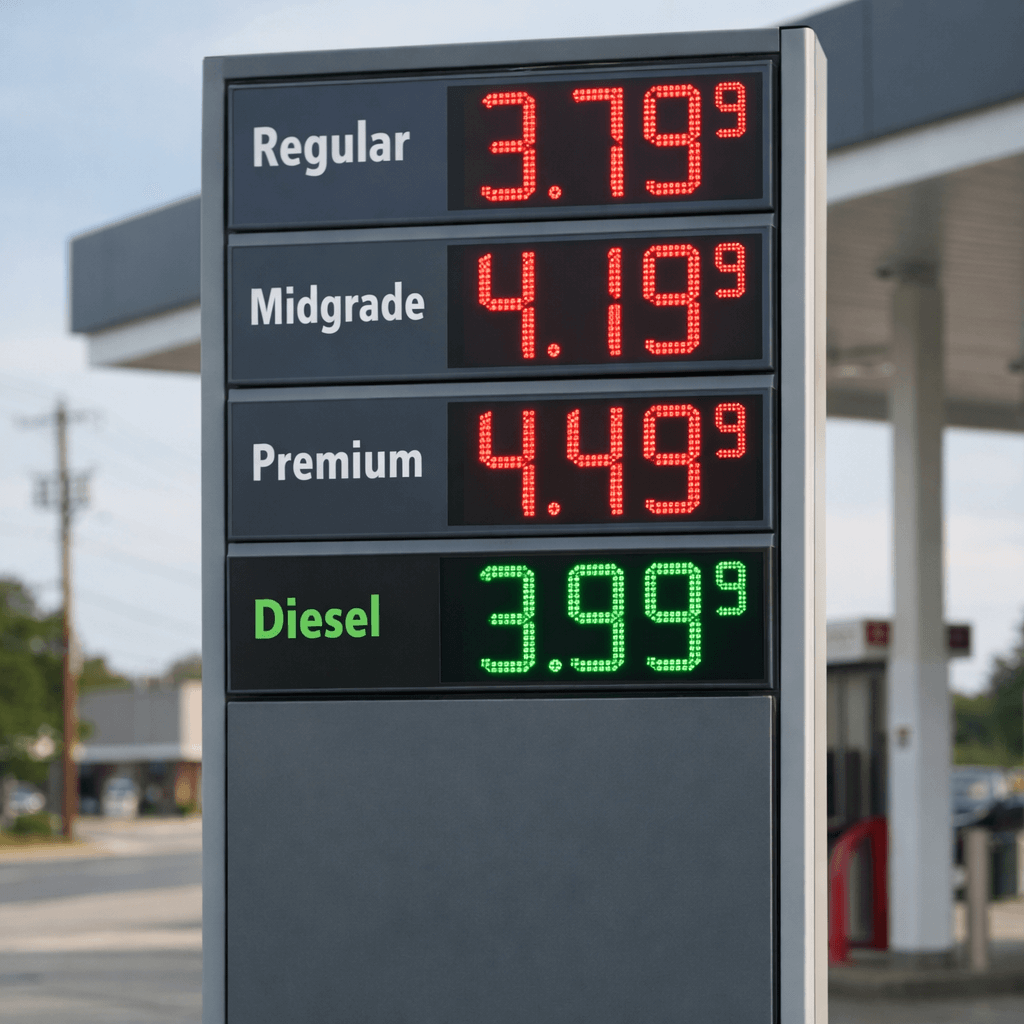
The best way to “win” against volatile gas prices is to buy less — or even stop depending on it altogether. Check out our 10 strategies for reducing gasoline use and the Electric vs Gas Calculator to estimate how much you could save on fuel and maintenance costs. It could be thousands of dollars, year after year.
The Top 4 Ways to Find Gas Prices Near You
1. GasBuddy — Best Overall for Local Price Comparisons
GasBuddy remains one of the most reliable ways to check station-by-station prices near you. Prices are often updated by drivers and stations themselves, making it useful for quick comparisons.
Tips to use it well
- Sort by price, but check how recently the price was updated.
- Compare stations that are already near your route. Don’t assume the cheapest station is worth a detour.
2. Waze — Best If You’re Already En Route
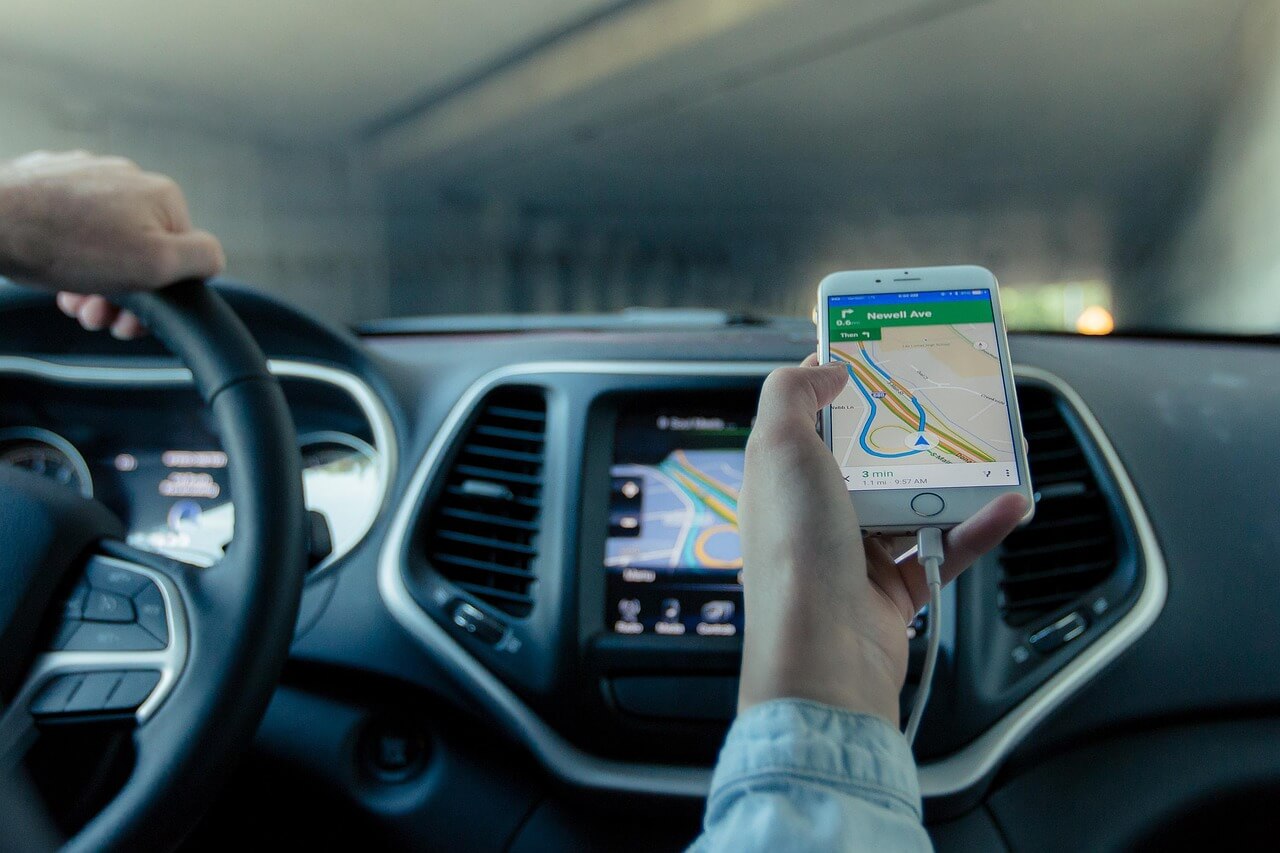
Waze shows gasoline prices along your route and nearby, which makes it especially useful when you’re already on the road. Prices are community-updated, so accuracy improves in high-traffic areas.
Tips to use it well
- Search for gas stations from your navigation screen.
- Focus on stations on your route, not just the absolute lowest price.
- Treat prices as estimates — always check the sign before pulling in
Learn how to see gas prices on Waze.
3. Google Maps — Best for Convenience
Google Maps often displays gas prices directly on station listings, alongside hours, directions, and reviews. Coverage varies by location, but it’s a fast first check.
Tips to use it well
- Tap multiple nearby stations to compare.
- Use it when you already need directions.
- If prices don’t show, switch to GasBuddy or Waze.
Learn how to see gas prices on Google Maps.
4. AAA Gas Price Finder — Best for Context
AAA’s gas tools help understand local and state-level averages, even if they don’t always show every individual station.
Tips to use it well
- Use AAA to see if prices in your area are generally high or low.
- Pair it with another app to choose the exact station.
Why Driving Out of Your Way Is Often Not Worth It
It’s tempting to drive farther to save a few cents per gallon, but those savings disappear quickly once you factor in extra miles and time.
A simple way to think about it:
- Savings = price difference × gallons purchased
- Cost = extra miles ÷ MPG × gas price (+ the value of your time to take a detour)
As an example:
- Save $0.10 per gallon.
- Buy 12 gallons → $1.20 saved.
- Drive 10 extra miles.
- At 20 MPG, that’s 0.5 gallons burned.
- At $3.00 per gallon, that’s $1.50 in fuel alone.
That’s before counting the bit of extra wear and tear on your car or the value of your time.
10 Ways To Cut Down on Gas Use and Save More in 2026
1. Consider the Biggest Lever: Crunch The Numbers on Switching
If you want the largest potential savings on fueling your vehicle, this is where to begin.
The EV vs Gas Calculator helps estimate how much money you could save on fuel plus maintenance by switching from a gas car to an electric vehicle. For many drivers, especially those with long commutes or frequent trips and a vehicle that doesn’t get very many miles per gallon, the savings can be substantial.
Why this matters
- The more you drive, the more gas you buy.
- High-mileage drivers often see the biggest savings potential in fuel plus maintenance (no oil changes, spark plugs, timing belts, etc. for EVs).
- Cutting gasoline use also reduces air pollution.
If you’re a heavy driver, running the numbers can be eye-opening. The next car you buy sets your fuel and maintenance costs for years to come.
2. Replace Short Trips When Possible
Walking, biking, or taking transit for short trips can reduce the need for gas purchases.
3. Combine Trips
Fewer trips mean fewer miles, fewer cold starts, and less fuel burned overall.
4. Carpool
Even one shared commute per week can noticeably reduce monthly gas spending.
5. Slow Down Slightly on Highways
Higher speeds use more fuel. Even small speed reductions can add up over a year of commuting.
6. Drive More Smoothly
Hard acceleration and last-second braking waste fuel. Smooth, steady driving saves gas.
7. Keep Tires Properly Inflated
Underinflated tires increase rolling resistance and fuel use. Check pressure regularly, especially during seasonal temperature changes.
8. Reduce Idling
Idling during long waits (school pickup lines, parking lots) adds up more than people realize.
9. Remove Extra Weight and Drag
Roof racks, cargo boxes, and unnecessary gear reduce fuel efficiency — especially at highway speeds.
10. Look at Costs Over a Year, Not a Week
Gas prices can swing widely from month to month, making it hard to predict what you’ll spend over time as opposed to the relatively steady prices of electricity. Looking at what you spend over a full year can reveal the real financial advantage of reducing—or eliminating—gas dependence.

Average U.S. Gasoline Prices Have Been Far More Volatile Than eGallon Electricity Costs
One of the clearest advantages of EVs is fueling stability. This Coltura chart compares monthly average U.S. retail gasoline prices with an electricity eGallon price estimate. It compares average gasoline prices with eGallon electricity costs and shows how much less turbulent electricity has been over time.
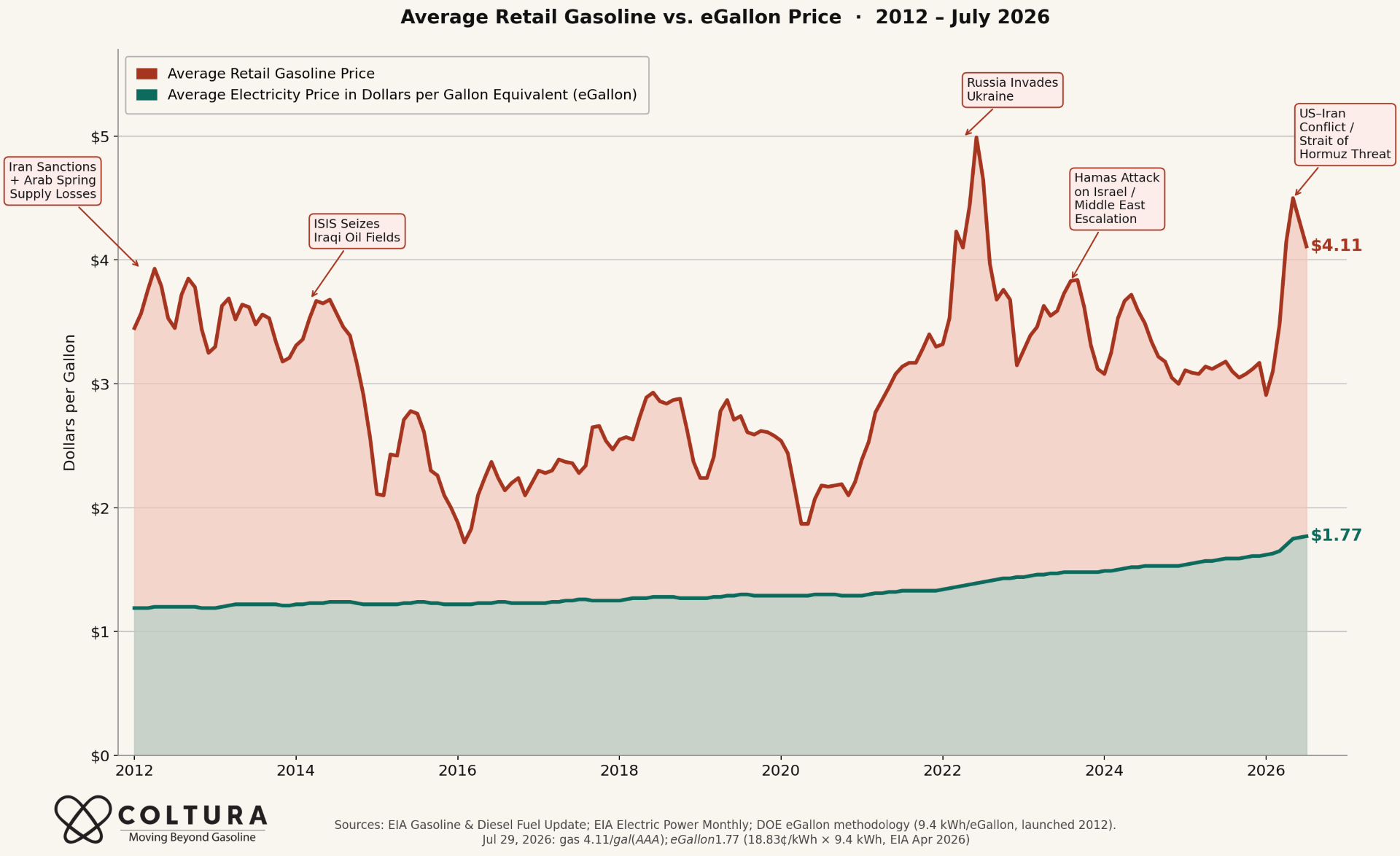
Interested in a more updated and interactive version of the above chart? Check out Coltura's EV Cost Savings Index
Conclusion
Checking gas prices near you is smart, and using apps can prevent overpaying. But the biggest savings usually don’t come from hunting for the perfect price — they come from using less gasoline overall.
For people who drive a lot, the math becomes even clearer. Running the numbers with Coltura’s EV vs Gas Car Calculator can show just how much fuel costs are adding up and how much could potentially be saved by switching.
Even if you’re not ready to switch today, understanding total costs can help you avoid locking in years of higher fuel and maintenance expenses when it’s time to replace your car. You can also easily shop new and used EVs near you with the EV Deal Explorer.
Lower gas use means lower costs, cleaner air, and less exposure to volatile fuel prices. In 2026, that’s a win on every front.
FAQ: Gas Prices Near You
Why are gas prices different near me?
Gas prices vary by station due to competition, supply contracts, operating costs, and the frequency with which the station refills its tanks.
What’s the best app to find gas prices near me?
GasBuddy is often the best all-around option, while Waze works well if you’re already driving, and Google Maps is convenient for quick checks.
Are gas price apps always accurate?
Prices are estimates. Always check how recently the price was updated and confirm it on the station sign.
Is it worth driving farther to save on gas?
Often, it is not worth it. Extra miles can cancel out small per-gallon savings.
Why do gas prices change so often?
Prices fluctuate based on oil markets, regional supply, demand, taxes, and when individual stations receive deliveries.
How can I save the most money on gas long-term?
The biggest long-term savings come from reducing or eliminating gas use. While driving less and more efficiently helps, switching from a gas car to an electric vehicle can dramatically cut fuel and maintenance costs, resulting in lower total cost of ownership. Using the EV vs Gas Calculator can help estimate how much you could save over time.
Who benefits most from switching away from gas?
Drivers who log more miles each year, such as long-distance commuters or people in rural areas where distances to amenities are far, and especially those driving inefficient vehicles that don’t get many miles per gallon see the most significant savings from switching to an electric vehicle. Because gas costs rise with every mile driven, high-mileage drivers typically benefit most when they compare costs using the EV vs Gas Calculator.
Haven't switched to an EV yet?
Imagine never having to visit a gas station again, or needing an oil change again or worrying about unpredictable gas prices. With an electric vehicle, this could be your reality—while potentially saving thousands of dollars a year.
Curious how much you could save switching to an EV? Get a quick estimate of your savings below!
*Disclaimer: This tool is only intended to provide an estimate of potential savings. Actual results will vary. Learn more about the calculation and the Electric vs Gas Calculator here.