


 Why Are Electric Cars Better Than Gas Cars?
The top 10 reasons why electric cars are better than gas.
Last updated: August 24, 2026

Electric cars are better than gas cars for many drivers because they are much more energy efficient, generally require less routine maintenance, can cost less to fuel, produce zero tailpipe emissions and deliver smooth, immediate acceleration.
Imagine never smelling gas station fumes again, cutting your fuel costs by an estimated 40 to 65 percent, and making a meaningful difference in reducing air pollution - all while enjoying a smoother, more advanced ride. That future isn’t a distant vision, it’s here now with electric vehicles (EVs).
EVs are reshaping the auto industry by providing a cleaner, smarter, and more cost-effective way to drive. With cutting-edge technology, drastically lower fuel and maintenance costs, and game-changing public health benefits, EVs are setting a new standard for more efficient and healthier transportation choices.
Whether you’re looking to save thousands on fuel and maintenance costs, embrace innovation, or make a lasting impact on air quality, now is the time to go electric.
In this comprehensive guide, our nonprofit breaks down the top 10 reasons why electric cars are better than gas cars in 2026. EVs are not just for the future - they’re the best choice today.

10 Reasons Electric Cars Are Better Than Gas Cars


Electric Cars vs. Gas Cars: A Quick Comparison
Why Electric Cars Have the Edge in 2026
As EV choices, charging options, and cleaner electricity continue to improve, electric cars offer more than lower emissions. They can also be cheaper, quieter, simpler to maintain, and more convenient for everyday driving.
| Category | Electric Cars | Gas Cars |
|---|---|---|
| Fueling & Energy | Cheaper cost per mile, more stable energy prices, and less dependence on oil markets | More exposed to gasoline price swings and oil supply disruptions |
| Maintenance | Fewer moving parts and less engine-related maintenance | Requires oil changes, exhaust repairs, belts, spark plugs, and engine servicing |
| Efficiency | Highly energy efficient with minimal wasted energy | Most fuel energy is lost as heat |
| Performance | Instant torque, smooth acceleration, and consistent power delivery without gear shifts | Performance depends on engine speed and transmission shifting |
| Noise | Much quieter operation, especially in city driving | Louder engines and more drivetrain vibration |
| Regenerative Braking | Recovers energy while slowing down and can reduce brake wear | Loses most braking energy as heat |
| Emissions & Air Quality | Zero tailpipe emissions and reduced local air pollution | Produces tailpipe CO₂ emissions and air pollutants |
| Convenience | Charge at home or work, use off-peak electricity or solar, and skip most gas-station stops | Quick refueling can help on road trips, but requires regular gas-station visits |
| Software & Features | Often includes advanced apps, over-the-air updates, and smart charging features | Software features and remote updates are typically more limited |
Looking To Save Money On An EV in 2026?
Our nonprofit has collected some of the best resources on purchasing or leasing an EV and put them into an easy-to-use cheat sheet.
It’s a must-read for people considering an EV.
Simply enter your email to access the free cheat sheet and receive monthly news and inspiration from our nonprofit.
1. Switch To Electric to Drastically Lower Maintenance Costs
Are Electric Cars Cheaper To Maintain Than Gas Cars?
Driving an EV means on average major savings on maintenance and fewer trips to the mechanic.
Electric vehicles (EVs) are engineered for efficiency, durability, and minimal upkeep - r saving time, money, and hassle for the the average driver.
- Unlike gas-powered cars packed with hundreds or even thousands of moving parts, EV drivetrains are designed with far fewer moving parts than internal combustion engines.
- EVs do not need oil changes, spark plugs, timing belts, fuel injectors, exhaust systems, or many of the routine engine-related services gas vehicles require - meaning there’s simply less to break, replace, or repair.
- EVs feature regenerative braking, an innovative technology that recaptures energy that would otherwise be lost during braking. This not only improves the energy efficiency of EVs but also extends the lifespan of brake pads and rotors.
- Electric vehicles also run on highly durable battery technology, with some lasting 400,000+ miles.
I drive a lot, spending like $1,000 a month with my gas car. Even with my hybrid, it’s like $500 a month. So I did the calculation, and having an EV is much better for me. And you just change windshield wipers and tires, and barely ever change the brakes. So no more big engine repair bills.

By driving an EV, you'll never have to make another oil change.
2. Electric Cars Offer Major Savings on Fuel Costs
By switching to an EV, you can enjoy dramatic long-term savings on fuel expenses.
- Charging an EV is significantly cheaper than fueling a gas vehicle per mile in all 50 states.
- For the average U.S. driver, this leads to savings of nearly $1,100 a year.
- For high-mileage drivers, this can add up to tens of thousands of dollars in fuel savings over the vehicle’s lifespan.
- For a personalized estimate, use Coltura's Electric Car Savings Calculator.
EV drivers also have the option of getting their electricity from free sunshine from solar panels or finding free public charging stations. Have you ever seen free gasoline?

Switching to an EV can save you 40-65% on fuel expenses annually.
Are Electric Cars More Efficient Than Gas Cars?
In addition to cheaper fuel costs, electric vehicles are exceptionally efficient. EVs convert much more energy into motion than gas-powered cars.
Gas-powered cars waste nearly 80% of energy from fuel, losing most of it as heat and inefficiencies in the engine.
In contrast, EVs lose only around 11% of their energy input, delivering more power to the wheels and even recapturing energy through regenerative braking.
Also, unlike gas engines that burn fuel even at a stop, EVs use power only when needed.
This superior efficiency means lower energy consumption, better performance, and reduced costs.Download the Ultimate EV Home Charging Cheat Sheet
We put together this free cheat sheet to help people learn about EV charging and how to purchase the right home charger. Simply enter your email to access the cheat sheet as well as sign up for other EV news and inspiration delivered straight to your inbox.

Source: Yale Climate Connections

Source: Yale Climate Connections
3. EVs Offer Price Stability and Protection from Gas Price Spikes
EV drivers enjoy fuel price stability and predictability.
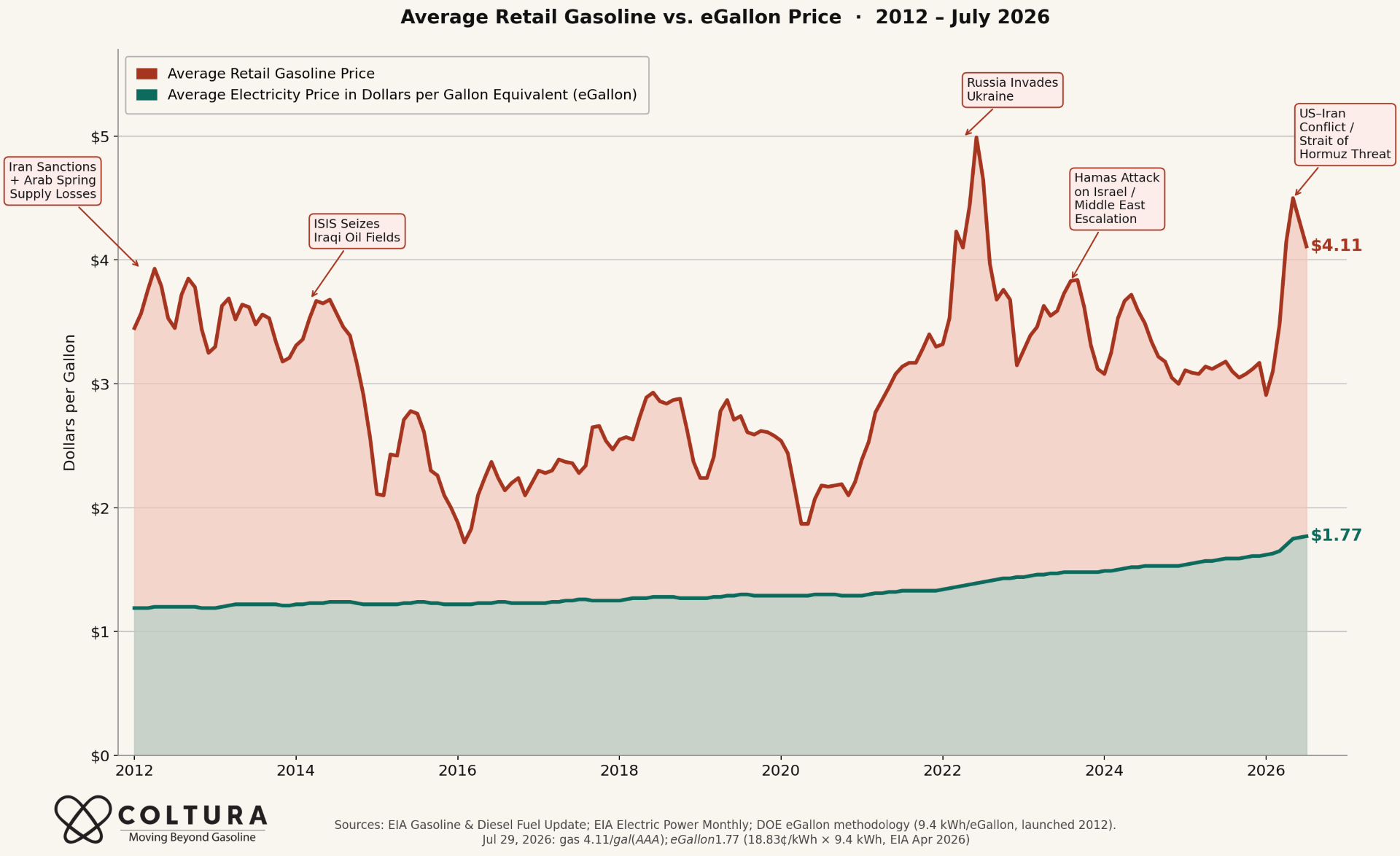
Gasoline prices are notoriously volatile, fluctuating due to global events, supply chain disruptions, and market speculation, making it difficult for drivers to budget fuel expenses.
In contrast, electricity rates are far more stable, allowing EV drivers to avoid unpredictable price swings. Many utilities also offer time-of-use (TOU) plans, enabling EV owners to charge at significantly lower rates during off-peak hours, further reducing costs and increasing savings.
With an EV, you get both lower fuel costs and cost stability for fewer surprises, and better long-term budgeting - something gas-powered drivers can’t count on.
It’s a little extra money up front, but you’re going to save in the long run. You’re way ahead of the curve, saving all this money on gas. And it’s a lot easier, because they’re better built and there aren’t these unpredictable problems popping out of nowhere.
4. EVs Offer Instant Acceleration and Power
Are Electric Cars Faster Than Gas Cars?
Electric vehicles (EVs) deliver instant torque for lightning-fast acceleration. Unlike gas-powered cars, which require gear shifts that momentarily interrupt acceleration, EVs use a single-speed transmission, ensuring uninterrupted power flow.
Gas engines typically rely on six to ten gears to optimize power output. In contrast, EVs deliver peak power instantly, eliminating delays and making acceleration feel effortless and smooth.
Some EVs hit 0-60 mph in under 3 seconds, a feat even supercars struggle to match. Many mainstream EV models that are not even performance-focused - including some SUVs - achieve it in under 5 seconds, rivaling sports cars.
Additionally, EVs accelerate faster from cruising speeds because they don’t require multi-gear downshifts. No lag, no hesitation - just smooth, immediate power.
Whether on city streets or open highways, EVs are redefining what it means to drive powerfully and efficiently.

5. Smooth, Stable & Quiet = A Superior Ride Quality
EVs are built for stability and control, thanks to their low center of gravity from battery placement. This enhances weight distribution, minimizes body roll (the tilting of a vehicle as it shifts weight in a turn), and improves cornering (how a vehicle maintains control while navigating a turn), making EVs feel both more planted and agile.
A lower center of gravity also reduces understeer, which occurs when the front tires lose grip, causing the car to push wide and not turn as sharply as intended, and reduces oversteer, where the rear tires lose grip, making the back end slide out and potentially spin the car.
The lower center of gravity reduces rollover risk, which offers a major advantage for electric SUVs and trucks. For example, the Ford F-150 Lightning (EV) has a rollover risk of just 12.7%, compared to 19.1% for the gas-powered F-150.
Beyond performance, EVs deliver a quieter ride - no engine noise, no gear shifts, and no exhaust rumble.
Without the vibrations and mechanical complexity of a traditional engine, EVs glide smoothly, making for a more comfortable and relaxing driving experience with almost no noise pollution.

EVs Can Help Reduce Traffic Noise
Long-term exposure to traffic noise has been linked with harmful health issues, including increased stress, sleep disruption, and a higher risk of cardiovascular diseases.
A large-scale transition to electric vehicles could significantly reduce traffic noise, with the average EV around 10 dB quieter than their gasoline and diesel counterparts.6. Electric Cars Can Save You Time
One of the hidden perks of electric vehicles (EVs) is how much time they can save for people who charge at home.
The average American spends 3 hours at the pump every year. This time is also spent breathing in toxic fumes such as benzene, toluene, ethylbenzene, and xylenes (BTEX), which are linked to lung irritation, asthma, neurological issues, organ damage, and even cancer.
But gas station visits take more time than just pumping fuel - driving out of one’s way, waiting in line, and payment can add 10–15 minutes per stop. Multiply that by dozens of fill-ups a year, and those minutes add up fast.
EV drivers skip gas station stops entirely. With 83% of charging happening at home in the US, most often just seconds are spent plugging in instead of making inconvenient fuel stops.
Even when charging on longer trips is needed, fast charging is more efficient than it seems - drivers can rest, eat, or catch up on emails while their car powers up, turning a refueling delay into a useful break.
Maintenance is another time drain that EV owners better avoid. As they require less maintenance with far fewer moving parts, EV owners don’t have to schedule time-consuming service appointments as frequently. Gas cars also require oil changes, engine servicing, and in many places emissions tests - all of which mean extra trips to service centers.
By eliminating gas stops and cutting maintenance time, EVs offer something invaluable - more time. For high-mileage drivers, who make even more fuel stops and service visits, the time savings can be even greater.

7. EVs Produce ZERO Tailpipe Emissions
Why EVs Are A Breath Of Fresh Air
More than half of all air pollution in the United States comes from mobile sources, and automobiles are the single largest mobile contributor. Every day, millions of gasoline vehicles pump toxic pollutants into the air, worsening public health and the environment.
Gas-powered vehicles release harmful pollutants such as carbon dioxide (CO₂), nitrogen oxides (NOₓ), and fine particulate matter (PM2.5), which degrade air quality and pose serious health risks to millions of Americans.
These toxic pollutants can seep deep into the lungs and bloodstream. They can lead to inflammation and significantly raise the risk of heart disease, strokes, respiratory illnesses, and cancers.
A staggering 99% of the global population inhales air pollution beyond the safe limits established by the World Health Organization (WHO).
Globally, air pollution from burning fossil fuels like gasoline is responsible for approximately 5.1 million premature deaths each year - a number comparable to the entire population of the D.C. metro area. It is the second leading risk factor for early death worldwide.
How Switching To EVs Provide a Healthier, Cleaner Future
Unlike gas-powered vehicles, electric vehicles (EVs) produce zero tailpipe emissions, eliminating harmful tailpipe pollutants that degrade air quality and harm public health. Instead of burning fossil fuels, EVs require no exhaust system.
A widespread transition to EVs leads to:
- Significantly improved air quality
- Fewer pollution-related respiratory and cardiovascular illnesses
- Healthier cities and communities with cleaner, safer air
Switching to electric isn’t just an environmental decision - it’s a critical step toward protecting public health and reducing pollution-driven diseases.

Tailpipe Emissions Visualizer
The Tailpipe Emissions Visualizer is grounded in research from the U.S. Department of Energy, which estimates that burning just one gallon of gasoline emits approximately 20 pounds of carbon dioxide (CO₂) into the atmosphere. Electric vehicles have 0 tailpipe emissions - no matter how many miles you drive them.
8. EVs Are Better For the Environment
Are Electric Cars Better For The Environment Than Gas Cars?
Even when accounting for electricity production and manufacturing, EVs generate far fewer emissions over their lifetime than gas-powered cars. In all 50 states, EVs produce lower annual emissions than gas vehicles.
While gas cars burn fuel and emit CO₂ their entire lifespan, EVs become cleaner the more they are driven. Gas vehicles produce 12 times more CO₂ over their lifetime than EVs. On average, an EV reaches its carbon break-even point in just 1.5 years of driving in the US - just 21,300 miles for cars and 17,500 miles for trucks. The exact timeline depends on factors such as where the battery is made and how clean the electricity is where the vehicle is charged.
As the energy grid gets cleaner, EVs will further reduce emissions. Replacing coal power plants with renewable energy plus battery storage is now cheaper than keeping them running. In other words, as power grids and battery production continue to become cleaner, this emissions “payback” period is expected to shrink even further.
The shift to EVs is not just about efficiency and cost savings – it’s one of the most impactful ways individuals can reduce air pollution.
Every time I get behind a diesel truck, I'm smelling the exhaust, and I'm like, I don't want to add to that, I don't want to pollute. That's something that I felt just makes you feel good about it right? You buy an EV for all the mature, responsible adult reasons. And then you find out, like wow, this is way more fun to drive than my other vehicle. The acceleration was extremely surprising. Way more fun on a winding road. So that’s the cool cherry on top, where this is the most fun vehicle I’ve ever driven.

Gasoline is the biggest source of carbon emissions in the U.S.
“Getting off gasoline is critical, yet very few organizations have put resources towards it. That’s why I joined Coltura.”
- Janelle London, Executive Director of Coltura
Read more about the Life Cycle Harms of Gasoline
9. Enjoy Cutting-Edge Technology
EVs are at the forefront of automotive innovation, constantly evolving with new technological advancements.
- Over-the-Air (OTA) Software Updates - Many EVs receive regular software updates that enhance performance, introduce new features, and fix potential issues remotely—without a trip to the dealership.
- Advanced Driver-Assist Systems (ADAS) - Many EVs also incorporate state-of-the-art safety features such as adaptive cruise control, automatic emergency braking, lane-keeping assistance, blind-spot monitoring, and even semi-autonomous driving capabilities.
- Bidirectional Charging & Vehicle-to-Grid (V2G) Capabilities - Some EVs can power homes during outages or feed energy back into the grid, making them a valuable asset for energy resilience.
- Smartphone App Integration - Many EVs offer advanced app controls, allowing drivers to:
- Remotely start or stop charging
- Preheat or cool the cabin before driving
- Track real-time battery status and range
- Find and navigate to charging stations with ease
- Customizable Driving Modes - EVs often come with custom driving modes (Eco, Sport, Comfort) that let drivers optimize power, acceleration, and range based on their needs.
- Augmented Reality (AR) Head-Up Displays (HUDs) - Some premium EVs now feature AR-based displays, projecting navigation, speed, and road hazard alerts onto the windshield for a more immersive and safer driving experience.
- One-Pedal Driving - EVs utilize regenerative braking to slow the car down and even stop it, allowing for one-pedal driving, which improves efficiency and reduces brake wear.
- Solar Integration - Some EVs integrate solar panels on the roof and hood, allowing drivers to extend their range using sunlight.
As EV technology continues to advance, automakers are investing heavily in battery improvements, charging infrastructure, and smart features, ensuring EVs remain ahead of the curve.

10. Better Future-Proof Your Ride
The future of transportation is electric, and EVs keep you ahead of the curve. As the world shifts toward cleaner mobility and phases out ICE cars, EVs are projected to make up over 50% of global auto sales by 2035.
The International Energy Agency reports that global electric car sales grew 20% in 2025 to more than 20 million vehicles, reaching about one-quarter of new car sales. The IEA expects electric car sales to reach 23 million in 2026, close to 30% of global car sales.
EVs are built to last longer and improve over time thanks to technological advancements:
- Longer Ranges - Lithium-ion batteries now power EVs for hundreds of miles per charge, with experimental models exceeding 1,000 miles and Toyota developing an EV expected to surpass 700 miles.
- Ultra-Fast Charging - EV charging is getting faster, with breakthroughs enabling charging in just minutes, including NASA’s latest tech that could charge an EV in five minutes.
- Declining Battery Costs - Since 2008, EV battery costs have dropped by 89% thanks to technology advancements and are expected to continue falling, making EVs even more cost-effective
- Next-Generation Battery Technology - Innovations in solid-state batteries and alternative materials like glass, cobalt-free, carbon nanotube, lithium metal, lithium-sulfur, sodium, graphene, and zinc air are set to further reduce costs and improve performance. Learn more about EV batteries.
- More Durability - Tesla is developing a 1-million-mile battery, while new research suggests EV batteries could eventually last 4 million miles - far outpacing gas-powered engines.
EVs aren’t just the future - they’re the smarter, cleaner, and more advanced way to drive today.
Gasoline Superusers
Did you know that in the U.S. just 10% of drivers consume 35% of all gasoline? US “Gasoline Superusers” make up less than 0.25% of the world’s population yet account for 10.4% of global gasoline use.
Low- and middle-income Superusers are hit hardest by high-mileage driving, spending on average 12.5% of their income on fuel.
Switching to an EV would save on average thousands in annual fuel costs.
Learn how much you could save by switching to an EV.

Conclusion
There is no need to rely on futuristic battery predictions to explain why electric cars have important advantages over gasoline vehicles today.
The measurable differences are already substantial: EVs use energy far more efficiently, eliminate tailpipe exhaust, require fewer routine drivetrain services, recover energy while braking and deliver power immediately. For drivers with home charging, they can also turn fueling into something that happens while the vehicle is parked.
For many everyday drivers an electric vehicle now offers a compelling combination of efficiency, operating savings, lower maintenance, cleaner local air and driving performance.
The time to make the switch is now. Embrace a driving experience that not only benefits you but also contributes to a healthier planet. Join the EV revolution and drive change, one mile at a time.

Haven't switched to an EV yet?
Imagine never having to visit a gas station again, or needing an oil change again or worrying about unpredictable gas prices. With an electric vehicle, this could be your reality—while potentially saving thousands of dollars a year.
Curious how much you could save switching to an EV? Get a quick estimate of your savings below!
*Disclaimer: This tool is only intended to provide an estimate of potential savings. Actual results will vary. Learn more about the calculation and the Electric vs Gas Calculator here.
Frequently Asked Questions
Are Electric Cars Better Than Gas Cars?
For many drivers, electric cars are better than gas cars because they are cheaper to fuel, usually cheaper to maintain, more energy efficient, quieter to drive, and produce zero tailpipe emissions. They also offer instant acceleration and a smoother driving experience because they do not rely on a traditional gas engine or multi-speed transmission.
Fr many U.S. drivers—especially people who drive a lot—switching to an EV can mean major savings. Estimate how much you could save with Coltura’s EV Savings Calculator.
Why Are Electric Cars Good?
Electric cars are good because they reduce gasoline use, cut tailpipe pollution, lower fuel costs, and make driving smoother and quieter. Since EVs do not burn gasoline while driving, they eliminate tailpipe pollutants that contribute to unhealthy air in communities near busy roads, highways, and gas stations.
EVs can also improve the everyday driving experience. They are quiet, quick, and simple to charge when home or workplace charging is available. They can also help reduce traffic noise, since electric vehicles are much quieter at low speeds than gasoline and diesel vehicles. Learn more about how electric cars can help reduce traffic noise.
How Do Electric Cars Compare To Gasoline-Powered Vehicles In Performance And Cost?
Electric cars compare very well to gasoline-powered vehicles in both performance and everyday operating costs. In performance, EVs deliver power instantly, which makes them feel quick and responsive in city driving, merging, and passing. In cost, EVs are cheaper to fuel because electricity is less expensive per mile than gasoline in all 50 states.
Maintenance is another major difference. EVs do not need oil changes, spark plug replacements, fuel injectors, exhaust systems, or many other engine-related repairs. Coltura’s research found that many U.S. drivers can save substantially by switching from gasoline to electricity, especially high-mileage drivers. Read Coltura’s EV savings report, or use the EV Savings Calculator to estimate your own potential savings.
Are Electric Cars Faster Than Gas Cars?
Electric cars are often faster than gas cars in everyday driving because electric motors deliver instant torque. A gas engine usually needs to rev up and shift gears before it reaches peak power, while an EV can send power to the wheels almost immediately.
Not every EV is a sports car, and not every EV is faster than every gas car. But many modern electric cars accelerate quickly, and some high-performance EVs are among the quickest production cars ever tested. See Car and Driver’s list of the quickest EVs tested.
Are Electric Cars More Efficient Than Gas Cars?
Yes. Electric cars are much more efficient than gas cars. Gasoline engines waste most of their fuel energy as heat, while EVs convert much more of their energy into motion. EVs also recapture some energy through regenerative braking and use little to no energy while stopped.
That efficiency is one reason EVs can cost less to drive per mile. Even when electricity is not free, an EV usually needs far less energy to travel the same distance as a comparable gasoline vehicle.
Do Electric-Powered Cars Have More Moving Parts Than Gasoline-Powered Cars?
No. Electric-powered cars generally have fewer moving parts than gasoline-powered cars, especially in the drivetrain. A gasoline vehicle depends on a complex engine, transmission, fuel system, exhaust system, spark plugs, belts, fluids, and many other parts that need service over time. A fully electric vehicle uses an electric motor and battery system instead of a gasoline engine.
Some articles use exact moving-part counts, but those numbers can vary depending on what parts are included in the comparison. The best way to say it is this: EVs have a simpler drivetrain and fewer routine maintenance needs. Learn more about why fewer moving parts can mean less maintenance.
What Are The Benefits Of An Electric Vehicle’s Simpler Design?
The benefits of an electric vehicle’s simpler design include lower maintenance needs, fewer oil-and-engine-related repairs, smoother acceleration, quieter operation, and better energy efficiency. EVs do not need oil changes, spark plugs, fuel injectors, mufflers, or tailpipes. Regenerative braking can also reduce wear on brake pads and rotors.
The battery is one of the most important parts of an EV, but modern EV batteries are designed to last for many years. Battery performance, charging speed, and durability continue to improve as the technology develops. Learn more in Coltura’s electric vehicle battery guide.
Are electric cars cheaper to maintain than gas cars?
Yes! Electric vehicles (EVs) require far less maintenance than gas cars because they have fewer moving parts and no need for oil changes, spark plug replacements, or exhaust system repairs. EVs have as few as 20-25 moving parts compared to the thousands in a traditional gas vehicle, significantly reducing repair costs over time.
How much can I save on fuel by switching to an EV?
Charging an EV costs 40-65% less than fueling a gas car, depending on electricity rates in your state. On average, U.S. drivers can save around $1,000 per year on fuel alone by going electric. Plus, EV owners can charge for free at public stations or use solar power at home for additional savings. Estimate how much you could save on the EV Savings Calculator.
Are Electric Cars Better For The Environment Than Gas Cars?
Yes, electric cars are better for the environment than gas cars over their average lifetime. EVs do require energy and materials to manufacture, especially for the battery. But once they are on the road, they produce no tailpipe emissions and are much more efficient than gasoline cars.
Even when electricity generation is included, EVs produce lower average lifetime climate emissions than comparable gasoline vehicles. The exact benefit depends on the vehicle, the battery size, how much the car is driven, and the local electricity mix. Read more about how EVs reduce carbon pollution across U.S. states, and learn more about lifecycle emissions for electric cars vs. gasoline cars.
How far can electric cars drive on a single charge?
EV range has dramatically improved, with most modern models achieving 200-400 miles per charge. Some upcoming models, such as Toyota’s next-generation EV, are expected to exceed 700 miles per charge. Learn more about EV battery advancements.
Do electric vehicles have better ride quality than gas cars?
Because their batteries are positioned low in the chassis, EVs have a low center of gravity, improving stability, handling, and cornering. EVs also eliminate engine noise, exhaust rumble, and gear shifts, making for an exceptionally smooth and quiet ride. EVs are up to 10 dB quieter than gas cars.
Are electric vehicles more reliable than gas cars?
EVs have fewer parts that can break, and their batteries are designed for long lifespans. Tesla is developing a 1-million-mile battery, and research suggests future EV batteries could last 4 million miles. See how long EV batteries last.
Will charging get faster in the future?
Yes! Fast charging technology is improving rapidly. NASA has developed technology that could enable EVs to charge in just 5 minutes. Read about NASA’s fast-charging breakthrough.
Will Electric Cars Replace Gas Cars?
Electric cars will likely replace gas cars over time. EV sales are growing globally, automakers are releasing more electric models, and many governments have adopted policies to reduce or phase out new gasoline vehicle sales. See which countries and regions are moving toward gasoline vehicle phaseouts.